Propagation lookup
Find how a genus is propagated and when to do it. Filter by genus or by method, then open the full steps.
All propagation methods
Search and filters need JavaScript. Every method is listed below, grouped by genus.
How to read this. Difficulty is a judgement for a home grower with ordinary equipment. Each genus entry lists the sources for its methods.
Aldrovanda
Propagating Aldrovanda, the waterwheel plant: break the rootless floating stem into pieces, and each piece carries on growing.
Full Aldrovanda entryModerate
Summer, while the plants are growing and branching strongly; temperate forms are dormant as turions from autumn to spring.
Snap or cut a healthy stem into pieces with at least three whorls of leaves and float each in the same tub of peat-stained water. Side branches form on their own and can be broken off as they lengthen.
Byblis
Propagating Byblis, the rainbow plants: mainly from seed, which needs smoke or gibberellic acid in all but one species. Larger annuals root from cuttings.
Full Byblis entryModerate
Annuals: sow in spring or any warm, bright season. Perennials: sow in autumn, or whenever a warm bright spot is available.
Pollinate, collect the pods a few weeks later, and sow on a sandy mix in warmth. B. liniflora and B. aquatica self-pollinate and germinate untreated; every other species needs pollen from a different clone and a smoke or gibberellic-acid treatment before it will germinate.
Moderate
During active growth, from side branches that have hardened slightly.
The large scrambling annuals, especially B. filifolia, B. rorida and the cultivar 'Goliath'; perennials can also be tried.
Cut side branches from the main stem, insert them in long-fibre sphagnum to root under humid, warm, bright conditions, then move the rooted cuttings to the usual sand and peat mix.
Moderate
Autumn or early spring, when growth is active and temperatures are mild.
The perennial species B. gigantea and B. lamellata.
The woody rootstock of the perennials develops several growing points over the years. Unpot, rinse, and cut the crowns apart with a few roots each.
Moderate
When a mature perennial is unpotted for division.
The perennial species B. gigantea and B. lamellata.
Lay 5 cm pieces of the oldest, thickest roots on the surface of the mix, cover lightly and keep damp, humid and bright. Plantlets appear in several weeks.
Cephalotus
Propagating Cephalotus, the Albany pitcher plant: leaf and pitcher pullings, rhizome and root pieces, division or seed. All methods are slow.
Full Cephalotus entryEasy
Spring to summer, while the plant is in growth; often done when repotting.
Pull a foliage leaf or pitcher from the rhizome with its pale base intact, lay it on damp mix under cover, and plantlets form at the base of the stalk. Faster than seed but slower and less certain than division.
Moderate
Late winter, when a large plant is unpotted at the end of its rest.
Pieces of rhizome and of the thicker, wiry roots from a large plant.
Cut the rhizome and thicker roots of a big plant into short pieces, lay them on cutting mix and cover lightly. Shoots appear in several weeks, quicker than from leaf pullings.
Easy
End of the winter rest, once the plant has several crowns.
A plant that has spread into several crowns can be split into rooted pieces at repotting time. Crown divisions and rooted stem cuttings are the quickest route to new plants.
Difficult
Pollinate the summer flowers daily as they open; sow as soon as the seed is ripe, a few weeks later.
Hand-pollinate between flowers, ideally between two clones, collect the hairy fruits and sow at once. Seed needs a cool damp period of six to ten weeks at around 15 C before it germinates, and seedlings grow about 2.5 cm a year.
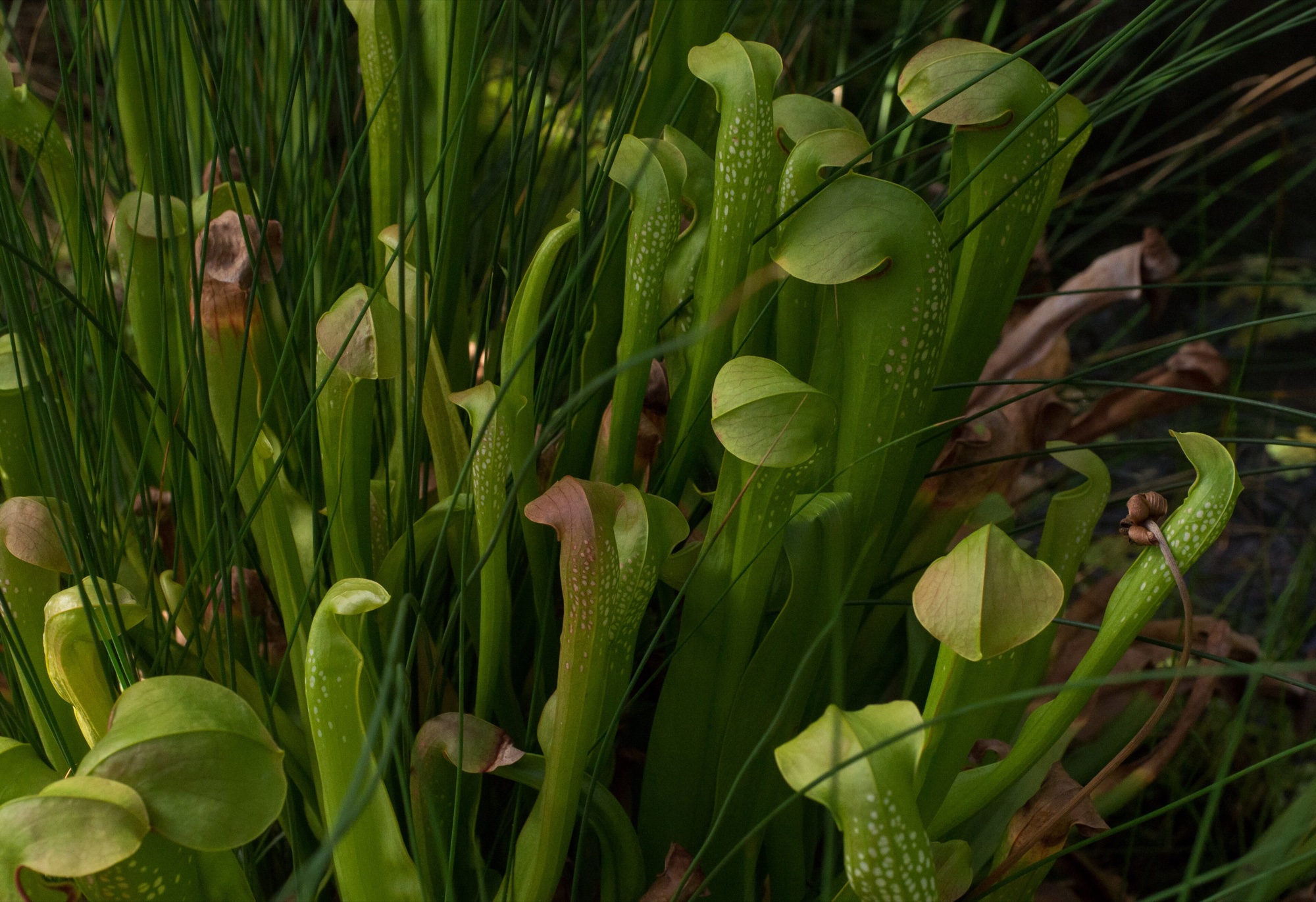
Darlingtonia
Propagating Darlingtonia, the cobra plant: cuttings of its underground runners are the dependable method. Seed and division also work.
Full Darlingtonia entryEasy
Late winter to early spring, once a plantlet is visible at the tip of a runner.
Mature plants send out long underground runners with small roots along them and a plantlet at the end. Cut a runner into rooted sections and lay them on sphagnum under cover, or simply pot the tip plantlet on its own.
Moderate
Pollinate in spring; harvest after two to three months; stratify and sow in late winter.
Hand-pollinate the single nodding flower, collect the bristly seed when the capsule browns, give it at least four weeks of damp cold, and sow on sphagnum. Seedlings are slow and need cool roots.
Moderate
Winter dormancy, before new growth.
Large established clumps can be split during dormancy. Each growing point needs its own roots, and new divisions want plenty of cool overhead watering while they settle.
Dionaea
Propagating Venus flytraps (Dionaea): from seed, division of clumps, leaf pullings and cut flower stalks. Commercial stock comes from tissue culture.
Full Dionaea entryModerate
Pollinate in spring as the flowers open; sow as soon as the capsules ripen, about six weeks later.
Hand-pollinate, collect the small black seed when the capsule dries, and sow it straight away on the surface of a peat and sand mix under humid cover. Seedlings need several years to reach trap-catching size.
Easy
Late winter to early summer, most conveniently while repotting at the end of dormancy.
Established plants form clumps through offshoots from the rhizome. Unpot the clump, separate the crowns where they join, and pot each piece that has its own roots.
Easy
Spring or early summer, when the plant is in active growth.
Pull a whole leaf away from the rhizome so that its pale base comes with it, lay it on damp mix under cover, and plantlets form at the base within weeks. Known to growers as leaf pullings.
Easy
Spring, when the flower stalk is still short.
A flower stalk cut while young can be laid on damp peat, where it produces plantlets at the nodes. Useful for growers who remove flower stalks anyway to spare the plant.
Difficult
Any time explant material is available; flower stalks in spring are a convenient source.
Nearly all flytraps sold commercially come from sterile culture. Seed, young leaves, flower buds and sections of flower stalk all work as starting material, but the method needs sterile technique and a gelled nutrient medium.
Drosera
Propagating Drosera, the sundews: the easiest carnivorous plants to multiply. Most sow themselves and nearly all grow from leaf cuttings.
Full Drosera entryEasy
Sow most species in late winter or early spring. Sow winter-growing tuberous and South African species in early summer onto dry medium and wet it in autumn. Temperate species need a damp cold spell first.
Many sundews self-pollinate as the flower closes and shed abundant seed. Collect it when the pods brown, store it cold, sow it thinly on the surface of the usual mix and keep it humid and bright. Temperate species need a few weeks of damp cold before they will germinate; tuberous species need warm, dry storage in the pot instead.
Easy
Start of the growing season, using fresh fully open leaves.
Nearly all species. Poor or useless for D. regia (use roots), D. burmannii (an annual, use seed), pygmies (use gemmae) and most tuberous species, which have too few leaves and too short a season.
Cut a healthy dewy leaf at the petiole and either lay it tentacle side up on wet medium under cover or float it in a sealed container of pure water. Plantlets sprout from the leaf surface after a month or more.
Easy
Early in the growing season or at the end of dormancy, usually at repotting.
Thick-rooted species: D. capensis, the fork-leaved sundews, D. regia, D. adelae and its relatives, and most rosetted subtropicals such as D. aliciae and D. slackii.
Cut pieces of the thick black roots about 5 cm long, lay them horizontally on medium under a very thin covering, and keep them humid and bright. Shoots appear in several weeks and the plants can reach maturity in a single season.
Easy
While dormant for temperate species; at the start of growth for the rest.
Clump-forming species: D. filiformis, woolly (petiolaris) sundews, D. aliciae, D. slackii, D. regia, the Queensland species that sprout from spreading roots, and D. prolifera, whose creeping flower stalks root a plantlet at the tip.
Species that form crowded clumps, or that throw plantlets from their roots or flower stalks, can simply be pulled apart at repotting and the pieces potted separately.
Easy
Late autumn to early winter, as days shorten; plant them within a month of their appearing.
Pygmy sundews (D. pulchella, D. scorpioides, D. nitidula x pulchella and the rest of the Western Australian pygmies).
Each autumn pygmy sundews produce a crown of tiny brood bodies that are flung off by raindrops. Knock or comb them off into a scoop, set each one on the soil surface at least 1 cm from its neighbours, and they root within weeks and are mature by spring.
Moderate
Lift and separate during summer dormancy, about a month after the foliage dies back; replant at the original depth and keep dry until autumn growth.
Tuberous sundews of Western Australia (D. hookeri, D. gigantea, D. macrantha, D. stolonifera, D. erythrorhiza and others).
These winter growers store themselves as underground tubers through the dry summer and many form daughter tubers on stolons. Separate the tubers while dormant, pot each one eye-up 5 to 10 cm deep in sandy mix, and keep the pot dry until the new stolon reaches the surface.
Difficult
Fresh seed, surface-sterilised and sown into sterile culture.
Most sundews start readily in sterile culture from surface-sterilised seed and multiply quickly on dilute nutrient gel. It is how nurseries produce clones in quantity, but it needs a sterile workspace and prepared media, so it is a project rather than a kitchen method.
Drosophyllum
Propagating Drosophyllum, the dewy pine: raised only from seed, as cuttings and division fail, so each seed is sown where the plant will spend its life.
Full Drosophyllum entryModerate
Flowers in spring; seed ripens a few weeks later. Sow in autumn, which matches the winter-rain germination of the wild plant.
Collect the large black seed in early summer, store it dry and cool, sow it in autumn on the surface of a gritty mix, and move each seedling into its permanent large pot before the root is disturbed. The plant can never be repotted afterwards.
Genlisea
Corkscrew plants are multiplied by leaf cuttings: a whole surface leaf with its pale base laid on very wet peat or sphagnum grows into a new plant.
Full Genlisea entryEasy
Any time the plant is in active growth; these are tropical plants without a dormancy.
Pull a complete green surface leaf, including the white portion at its base, and lay it on saturated peat or long-fibre sphagnum under the same warm, bright, humid conditions as the parent. Each leaf can produce a plantlet.
Heliamphora
Propagating Heliamphora, the sun pitchers: divide well-grown plants when they offset, or raise seed that needs no stratification. Division suits home growers.
Full Heliamphora entryModerate
When the plant is growing strongly and temperatures are cool; avoid hot spells above about 26 C (79 F).
Well-grown plants form several growing points and can be pulled or cut apart, each piece with roots. Feed and water beforehand, remove flower stalks, and keep the divisions humid until they resume growth.
Difficult
Pollinate as each flower opens, usually winter to spring; sow fresh when the capsule splits two to four months later.
The stigma is receptive for only a few days after a flower opens and before its own pollen is ripe, so pollen has to come from an older flower. Shake pollen out with vibration, brush it on, and sow the resulting seed fresh on sphagnum without stratification.
Nepenthes
Propagating Nepenthes, the tropical pitcher plants: stem cuttings, air layering, or fresh seed, which needs a male and a female plant in flower together.
Full Nepenthes entryModerate
Any time the plant is growing well; cuttings from vigorous growth root fastest. Wait until the plant has a basal rosette before removing a climbing stem.
Cut a climbing stem into pieces of one to three leaves, each with a node, and root them in damp sphagnum inside a sealed bag in bright indirect light. The dormant bud at each leaf base grows into the new plant.
Moderate
Growing season, on a vine with a long bare gap between leaves.
Root a section of climbing stem while it is still attached to the plant: wound the stem, pack it in moist sphagnum under plastic, and sever it below the roots once they show. The parent feeds the layer until it can feed itself, which avoids the rot that kills some detached cuttings.
Moderate
Pollinate when a male and a female are in flower at the same time; sow the seed the day it is collected.
Nepenthes are dioecious, so you need a flowering male and a flowering female, and you will usually get a hybrid. Dust pollen onto the sticky stigmas, collect seed when the capsules split, and sow at once on damp sphagnum in a warm, humid, shaded place.
Difficult
Seed is sown into sterile culture as soon as it is ripe.
Laboratory culture from seed is how most rare species now reach the market, but it needs sterile technique, prepared media and a clean workspace, so it is not a kitchen-table method. Vegetative culture of selected clones is harder still.
Pinguicula
Propagating Pinguicula, the butterworts: by seed, winter leaves of Mexican species, gemmae of temperate species, and runners in one Spanish species.
Full Pinguicula entryEasy
Late winter to early spring, just before or as the first sticky summer leaves appear; in the northern hemisphere this is roughly late March to early April for plants on a natural light cycle.
Mexican and other tropical species that form a compact succulent winter rosette (P. moranensis, P. esseriana, P. ehlersiae and their hybrids). Species without a true winter rosette, such as P. gigantea and P. agnata, can be pulled at any time of year. Not applicable to temperate species.
Detach a few of the small, dry winter leaves and lay them on a barely damp surface under humid cover. New plantlets form at the base of each leaf within one to two months.
Moderate
Pollinate when flowers open; sow as soon as the capsule splits. Seed of cold-temperate species needs a winter chill before it will germinate.
Nearly all species need hand pollination, because the stigma is a flap that covers the anthers. Transfer pollen to the outer face of that flap, collect the seed when the capsule browns and splits, and sow it at once on the surface of the usual mix.
Easy
Late winter or very early spring, just before growth starts; gemmae can also be separated in autumn when the bud is fully formed.
Temperate species that overwinter as a tight bud (hibernaculum); P. grandiflora and P. corsica produce the most, up to about fifty per plant.
Temperate butterworts form small brood buds around the base of the winter bud. Separate them with forceps and set each one upright on the usual mix, where it grows into a new plant over the season.
Easy
Runners form in summer after flowering; the connection to the parent usually decays over winter, so separate the young plants in autumn or the following spring.
P. vallisneriifolia only, a temperate species from southern Spain that spreads by runners instead of gemmae.
This one species sends out runners that root a few centimetres from the parent. Let the plant produce them, then lift the rooted offsets once the link to the mother plant has withered.
Sarracenia
Propagating Sarracenia, the American pitcher plants: cold-stratified seed, division at the end of dormancy and rhizome sections. Division is quickest.
Full Sarracenia entryModerate
Pollinate in spring within a day or two of the flower opening; harvest in autumn; stratify over winter and sow in late winter.
Hand-pollinate the five stigmas, collect the dry capsule in autumn, give the seed four to eight weeks of damp cold, then sow it on the surface of a peat and sand mix in warmth. Plants flower after four to seven years.
Easy
During dormancy or just as spring growth starts; not summer or autumn.
Most species add growing points every year and can be pulled apart at the end of dormancy. Give each division roots and, ideally, more than one growing point.
Moderate
At the same time as division, while the plant is dormant or just waking.
Sections of healthy rhizome 5 to 7.5 cm long will sprout new growing points when potted horizontally. An old rhizome can also be notched in place to force new shoots for division the following year.
Utricularia
Propagating Utricularia, the bladderworts: mostly by division, using soil plugs for terrestrials, stolon pieces for epiphytes and stem lengths for aquatics.
Full Utricularia entryEasy
Start of the growing season, which for most terrestrials is spring; for winter-growing or tuberous species, as growth resumes.
Terrestrial and epiphytic species. Aquatic species are covered under fragmentation.
Bladderworts have no roots, only creeping stems that run through the medium, so any plug of soil that contains them will grow on. Cut out a piece, set it in fresh mix at the same level, and keep it wet.
Easy
Any time the plants are in active growth; spring is best for temperate species emerging from turions.
Aquatic species such as U. gibba, U. vulgaris, U. macrorhiza and U. inflata.
Aquatic bladderworts are floating stems with no roots. Cut off a piece a few centimetres long, drop it into suitable water, and it grows into a new plant.
Easy
Growing season.
Species with large leaf-like stolons, chiefly the epiphytes (U. longifolia, U. alpina, U. reniformis) and larger terrestrials such as U. praelonga.
The leaf-like organs of bladderworts are really photosynthetic stolons, and a piece of one laid on wet medium will sprout. Treat them like Drosera leaf cuttings.
Moderate
During dormancy, when the foliage has died back; replant as the resting period ends.
Epiphytic and seasonal species that rest as small tubers, including U. reniformis, U. alpina and U. menziesii.
Several epiphytic and drought-adapted species die back to small tubers each year. Dormant tubers can be separated at repotting and potted up singly, and a division that carries a tuber establishes much faster than one without.
Moderate
Pollinate as flowers open; sow at the start of the growing season, or at once for species whose seed does not keep.
Most species need hand pollination, done as for Pinguicula with a toothpick or a needle for the tiniest flowers. Sow on the surface of wet medium and keep the pot in a bag with a little water in the bottom.
No methods match. Try a shorter search term or remove a filter. The lookup currently covers 13 genera.
New to carnivorous plants?
The beginner path explains choosing a plant, water and media, light and dormancy in four short lessons. The plant group pages introduce each genus, and the species library covers each plant in detail.