Lesson 2
Understanding water and growing media
Why carnivorous plants are harmed by ordinary tap water and potting compost, which alternatives work, and how to water without guessing.
Every group of carnivorous plants evolved in places where the water and soil carry almost no dissolved minerals: rain-fed bogs, seepages over bare rock, white sand soaked by rain. Carnivory is how they get the nitrogen and phosphorus that other plants take from the soil. The consequence for growers is simple and non-negotiable: the water and medium must be as poor in minerals as the habitat.
Water
Why tap water is a problem
Tap water carries dissolved salts, mainly calcium and magnesium compounds, along with treatment chemicals. In a normal pot these are harmless or useful. In a carnivorous plant’s pot they accumulate, because the plant draws water up and leaves the salts behind, and over weeks and months they burn the roots. The plant does not die at once; it weakens, stops producing new growth and then rots or dries out. Growers who measure water use a total dissolved solids (TDS) meter and commonly look for readings below about 50 parts per million; tap water under about 90 ppm is acceptable. Many tap supplies are several times that.
Water that works
- Rainwater, collected from a roof into a clean butt or barrel. The cheapest supply and the one most growers use. Let the first flush of a storm run off a dirty roof, and keep the container covered.
- Distilled water, sold for irons and dehumidifiers. Reliable and mineral-free, but costly for a large collection.
- Reverse-osmosis (RO) water, from a domestic filter or from aquarium shops. Equivalent to distilled for this purpose.
- Water from a dehumidifier or air conditioner condensate is low in minerals and is used by some growers; filter out dust and check it has not picked up oil or metal from the unit.
Bottled spring and mineral water, “filtered” jug water and softened water are not suitable. Softeners replace calcium with sodium, which is worse.
How to water
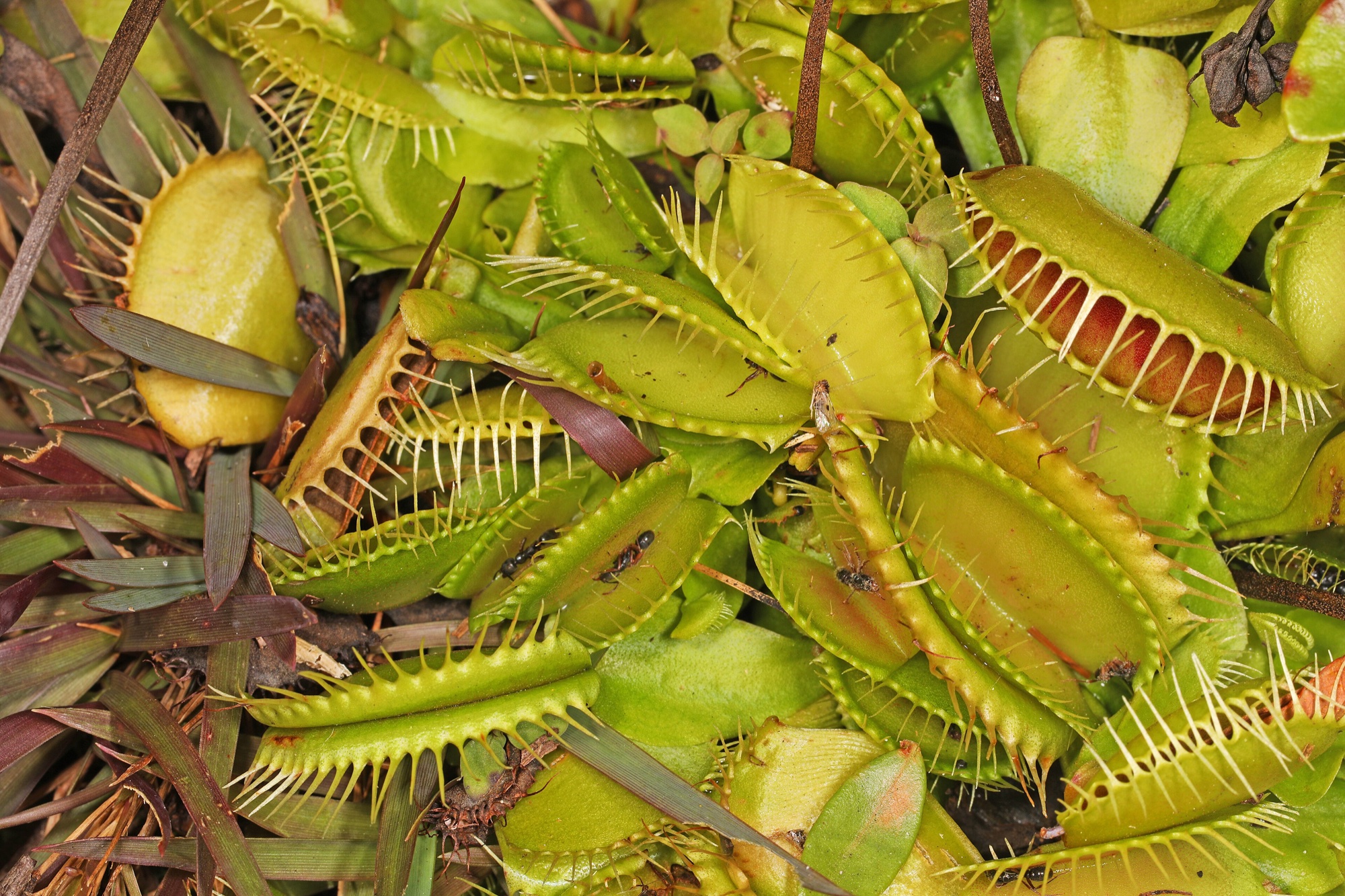
Most bog species (Venus flytraps, Sarracenia, most sundews, terrestrial bladderworts) are watered by the tray method: the pot stands in a saucer or tray holding a centimetre or two (around half an inch) of water, and the medium stays wet from below. Refill when the tray empties; let it stand empty for a day in cooler weather before refilling so the medium is not permanently saturated.
Nepenthes and Mexican butterworts are the exceptions. They want a medium that is moist but drains freely, so water them from above and never leave them standing in water.
In winter, dormant plants need far less: keep the medium damp rather than wet. A plant kept wet, cold and dark is a plant that rots.
Growing media
Why potting compost fails
Ordinary compost is designed to feed plants. It contains fertiliser, often lime, and decomposed organic matter rich in the minerals carnivorous plants cannot tolerate. Even “ericaceous” compost sold for acid-loving plants usually contains fertiliser. Read the bag; if it mentions feeding the plant for any number of weeks, do not use it.
The standard ingredients
- Sphagnum peat moss: acidic, nutrient-poor and water-retentive. The base of most mixes. Check that it has no added fertiliser or lime.
- Long-fibre sphagnum moss: the dried whole moss, which holds water and air at the same time. Excellent alone or as part of a mix, especially for Nepenthes and small sundews.
- Perlite: expanded volcanic glass. Adds air spaces and drainage. Rinse thoroughly before use; some perlite and pumice carries salts, and sand is the safer choice.
- Washed silica (quartz) sand: coarse horticultural sand, not builder’s or beach sand, which carry salts or lime. Adds drainage and weight.
- Pumice or lava rock, vermiculite: used mainly in mineral mixes for Mexican butterworts.
A general mix for Venus flytraps, Sarracenia and sundews is roughly equal parts peat and perlite or sand. Nepenthes want something more open, such as sphagnum with perlite and orchid bark. Mexican butterworts prefer a largely mineral mix with only a little peat. Each species profile gives its own recommendation.
Peat extraction damages the bogs that wild carnivorous plants depend on, and growers are testing alternatives: chopped sphagnum with sieved pine bark is one option, coir another. Results vary and alternatives can carry salts; rinse thoroughly and check the species profile before experimenting with a valuable plant.
Reading the plant
- Too dry: leaves droop or dry from the tips, sundews lose their dew, the medium pulls away from the pot. Recover by standing the pot in deep water for a few hours.
- Too wet, too cold or too dark: growth slows, the base of the plant darkens and softens, a sour smell appears. Reduce water, increase light and airflow, and remove rotting material.
- Mineral damage: a white crust on the medium surface or the pot rim, browning leaf tips, a gradual decline with no obvious cause. Flush the pot with several volumes of pure water or repot into fresh medium.
The next lesson deals with the condition that decides more than any other whether a carnivorous plant thrives: light.
Sources
References for the facts on this page.