Propagation
Propagating Nepenthes
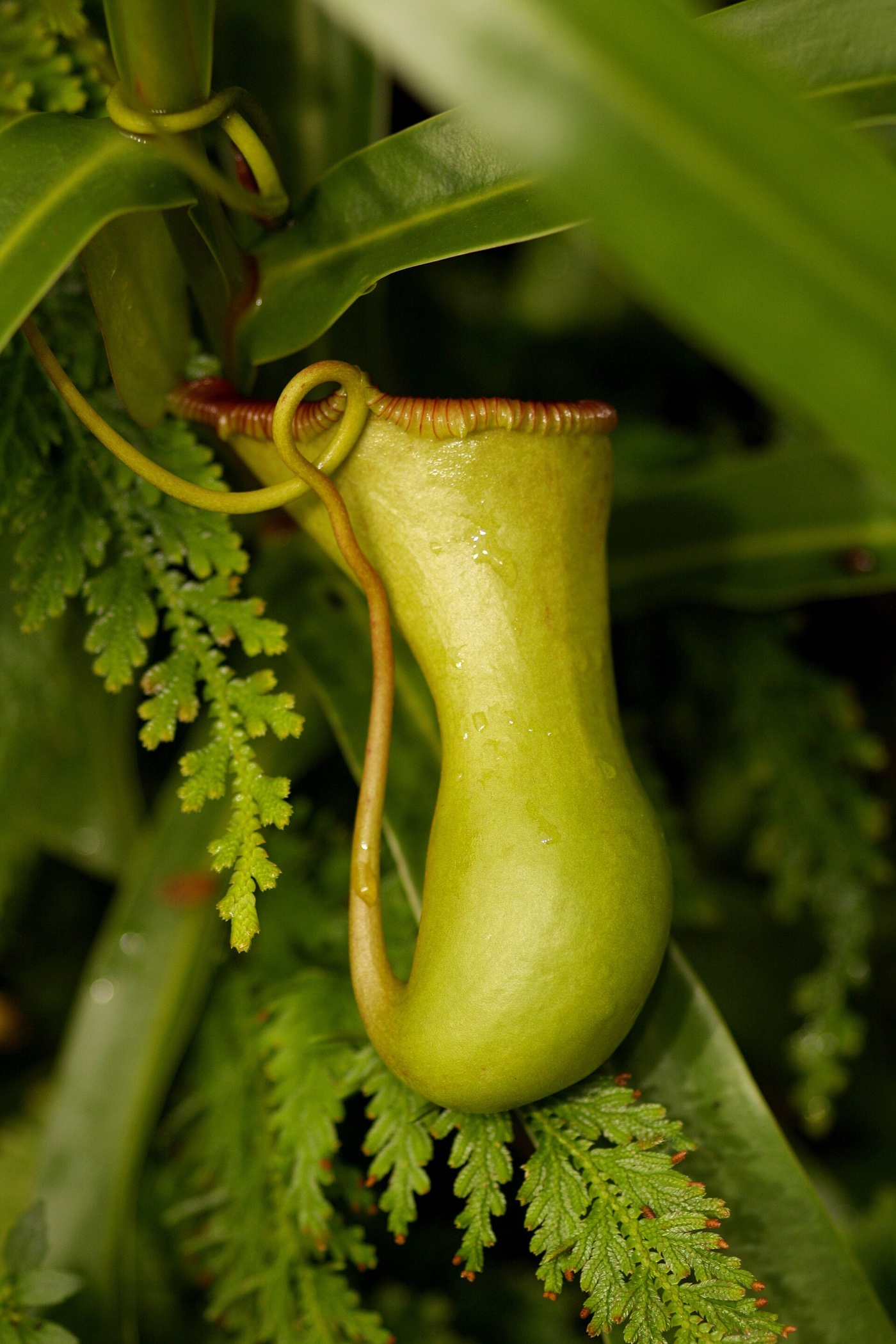
Propagating Nepenthes, the tropical pitcher plants: stem cuttings, air layering, or fresh seed, which needs a male and a female plant in flower together.
Nepenthes are vines, and that shapes everything about propagating them. Once a plant has thrown a climbing stem and a fresh basal rosette, the stem can be cut into pieces and rooted, which is the method to try first and the only way to multiply a named clone. Pruning the vine also prompts more basal shoots, so a mature plant in a large pot can be harvested for cuttings for years. Seed is a lottery: you need plants of both sexes in flower together, the seed dies within weeks, and the seedlings take years, but it is how new hybrids and most tissue-cultured species begin.
Stem cuttings
Moderate
When: Any time the plant is growing well; cuttings from vigorous growth root fastest. Wait until the plant has a basal rosette before removing a climbing stem.
Cut a climbing stem into pieces of one to three leaves, each with a node, and root them in damp sphagnum inside a sealed bag in bright indirect light. The dormant bud at each leaf base grows into the new plant.
- Choose a healthy plant with a climbing stem and a new basal rosette. Remove the stem with a clean blade; cutting under water helps keep air out of the stem.
- Cut the stem into sections of one to three leaves. Cut a few millimetres above a leaf attachment so the growth bud stays with the section below. Two-node pieces are the most reliable; one-node pieces from the tip yield more plants but fail more often.
- Remove the lowest leaf so the bottom node can be buried, and remove pitchers so the cutting fits in a bag. Halving the remaining leaves is optional; it is unnecessary in a sealed bag.
- If you use rooting hormone, touch the cut end to a little powder tipped onto paper or brush on a trace of liquid at soft-wood strength; never dip into the jar, and expect no real benefit.
- Push the base into damp long-fibre sphagnum, or a 1:1 mix of sphagnum with perlite, with at least one node below the surface. Lay short one-node pieces horizontally, leaf up, under 3 to 5 cm of medium.
- Label with the date, seal the pot in a clear bag, and set it in bright light out of direct sun at the parent's growing temperature. Mist if the medium dries.
- Once new growth appears, pot up and open the bag gradually over a couple of weeks to harden the plant to lower humidity. Vigorous species such as N. gracilis will also root in a jar of plain water if the water is changed often and humidity is high.
- Medium
- Damp long-fibre sphagnum, or sphagnum and perlite 1:1; rock wool and well-rinsed coir with perlite also work. Damp, never sodden.
- Conditions
- Sealed bag or propagator for very high humidity, bright indirect light, the same temperature as the parent plant.
- Time to result
- Roots and a new shoot in anything from a month to a year depending on species and vigour; keep a cutting as long as it stays green.
Watch out for
- Rooting hormone is optional at most. Some growers use a hormone with fungicide, but hormone is generally unhelpful and a strong dose can stop roots forming altogether; a cutting that callouses but never roots is the sign.
- A cutting with its only growth bud above the medium produces aerial rosettes that snap off easily; bury a node.
- Dead cuttings left in the bag spread rot; remove them promptly.
- A few species, notably N. khasiana, root so poorly from cuttings that tissue-cultured plants are the practical source.
- Taking the tip from a plant with no basal rosette leaves it leafless; leave at least four green leaves on the parent.
Sources for this method
- Peter D'Amato, The Savage Garden, Revised Edition (Ten Speed Press, 2013), The Tropical Pitcher Plants chapter, propagation section. ISBN 978-1-60774-410-8
- Nepenthes Propagation via Stem Cuttings (International Carnivorous Plant Society) (accessed )
Air layering
Moderate
When: Growing season, on a vine with a long bare gap between leaves.
Root a section of climbing stem while it is still attached to the plant: wound the stem, pack it in moist sphagnum under plastic, and sever it below the roots once they show. The parent feeds the layer until it can feed itself, which avoids the rot that kills some detached cuttings.
- Pick a node on a healthy vine with plenty of stem on either side. Make a shallow angled cut partway into the stem just below the node, or remove a narrow ring of outer tissue.
- Pack a handful of moist long-fibre sphagnum around the wound and wrap it in plastic film, tied at both ends so it stays moist but not dripping.
- Check every few weeks; keep the moss damp. When roots are visible through the plastic, cut the stem below the rooted section and pot it up in the usual Nepenthes mix without disturbing the root ball.
- Keep the new plant under high humidity for a few weeks while it adjusts.
- Medium
- Moist long-fibre sphagnum inside a plastic wrap; pot into the usual open Nepenthes mix.
- Conditions
- As for the parent plant; the wrap must stay moist throughout.
- Time to result
- Roots in a few weeks to several months depending on the species.
Watch out for
- Cutting too deeply weakens or snaps the stem.
- A wrap that dries out stops rooting; a wrap that stays sodden invites rot.
Sources for this method
- Peter D'Amato, The Savage Garden, Revised Edition (Ten Speed Press, 2013), The Tropical Pitcher Plants chapter, propagation section. ISBN 978-1-60774-410-8
- Air layering of plants (Royal Horticultural Society) (accessed )
Seed
Moderate
When: Pollinate when a male and a female are in flower at the same time; sow the seed the day it is collected.
Nepenthes are dioecious, so you need a flowering male and a flowering female, and you will usually get a hybrid. Dust pollen onto the sticky stigmas, collect seed when the capsules split, and sow at once on damp sphagnum in a warm, humid, shaded place.
- Identify the sexes: males carry yellow pollen on the stamen tips, females show a swelling below the tepals. Flowers open a few at a time from the bottom of the spike over several weeks.
- Transfer pollen with a clipped male flower held in forceps or with a fine brush, or shake pollen onto foil and brush it on. Pollinate repeatedly as new flowers open and label the spike. Pollen keeps up to a year wrapped in foil in the freezer.
- Capsules swell for several weeks, turn brown and split, each releasing a few hundred thread-like seeds. Sow immediately; germination falls with every week of storage.
- Sow sparsely on the surface of damp milled or chopped sphagnum, or peat with sand or perlite, or rinsed coir. Spray with pure water, bag the pot and keep it in light shade or under lights at about 26 to 32 C (80 to 90 F).
- Remove the bag once seedlings are up, watch for mould, and prick out when small rosettes have formed after six to twelve months. Feed very lightly in the first year.
- Medium
- Milled or chopped long-fibre sphagnum, peat and sand, peat and perlite, or rinsed coir, kept very damp but not wet.
- Conditions
- Warm (26 to 32 C), humid, bright shade or grow lights, no direct sun.
- Time to result
- Germination in 4 weeks to nearly a year; plants of good size in three to five years.
Watch out for
- Seed is short-lived and killed by freezing; even refrigeration can kill seed of lowland species. Roughly half the seed that reaches the ICPS seed bank arrives dead.
- Wild sex ratios run about 70 percent male, so females are scarce in collections; without one there is no seed.
- In the wild the flowers are pollinated by insects, mainly flies; indoors nothing will do it for you.
Sources for this method
- Peter D'Amato, The Savage Garden, Revised Edition (Ten Speed Press, 2013), The Tropical Pitcher Plants chapter, propagation section. ISBN 978-1-60774-410-8
- Growing Nepenthes (International Carnivorous Plant Society) (accessed )
- Sowing Carnivorous Plant Seeds Step-by-Step (International Carnivorous Plant Society) (accessed )
Tissue culture
Difficult
When: Seed is sown into sterile culture as soon as it is ripe.
Laboratory culture from seed is how most rare species now reach the market, but it needs sterile technique, prepared media and a clean workspace, so it is not a kitchen-table method. Vegetative culture of selected clones is harder still.
- Surface-sterilise fresh seed and sow it on a sterile gel medium in sealed vessels under lights.
- Transfer germinated shoots to a multiplication medium, then to a rooting medium, subculturing every few weeks.
- Wean rooted plantlets out of the flask into sphagnum under very high humidity, lowering it over several weeks.
- Medium
- Sterile agar media; for N. khasiana, half-strength Murashige and Skoog salts with a cytokinin for shoots and an auxin for rooting.
- Conditions
- Sterile flasks under lights; weaned plants in a sealed propagator at normal Nepenthes temperatures.
- Time to result
- Months in culture; in-vitro seed germination alone can take about 180 days without hormone treatment, and around 65 percent of plantlets survive the move to a glasshouse.
Watch out for
- Contamination of the flasks is the usual failure for amateurs.
- Clonal cultivars cannot generally be started in culture from cuttings because their tissue is hard to sterilise without killing it; they are multiplied by cuttings instead.
Sources for this method
- Peter D'Amato, The Savage Garden, Revised Edition (Ten Speed Press, 2013), The Tropical Pitcher Plants chapter, propagation section. ISBN 978-1-60774-410-8
- Joshi, B., Panwar, G. S. and Singh, S. K. 2021. In vitro propagation of insectivorous plant Nepenthes khasiana Hook. f., an endangered ornamental and ethnomedicinal species. Vegetos 35(2): 534-539 (accessed )
Sources
References for the facts on this page.
- Peter D'Amato, The Savage Garden, Revised Edition (Ten Speed Press, 2013), The Tropical Pitcher Plants chapter. ISBN 978-1-60774-410-8
- International Carnivorous Plant Society growing guide and propagation pages for Nepenthes (accessed )