Propagation
Propagating Dionaea
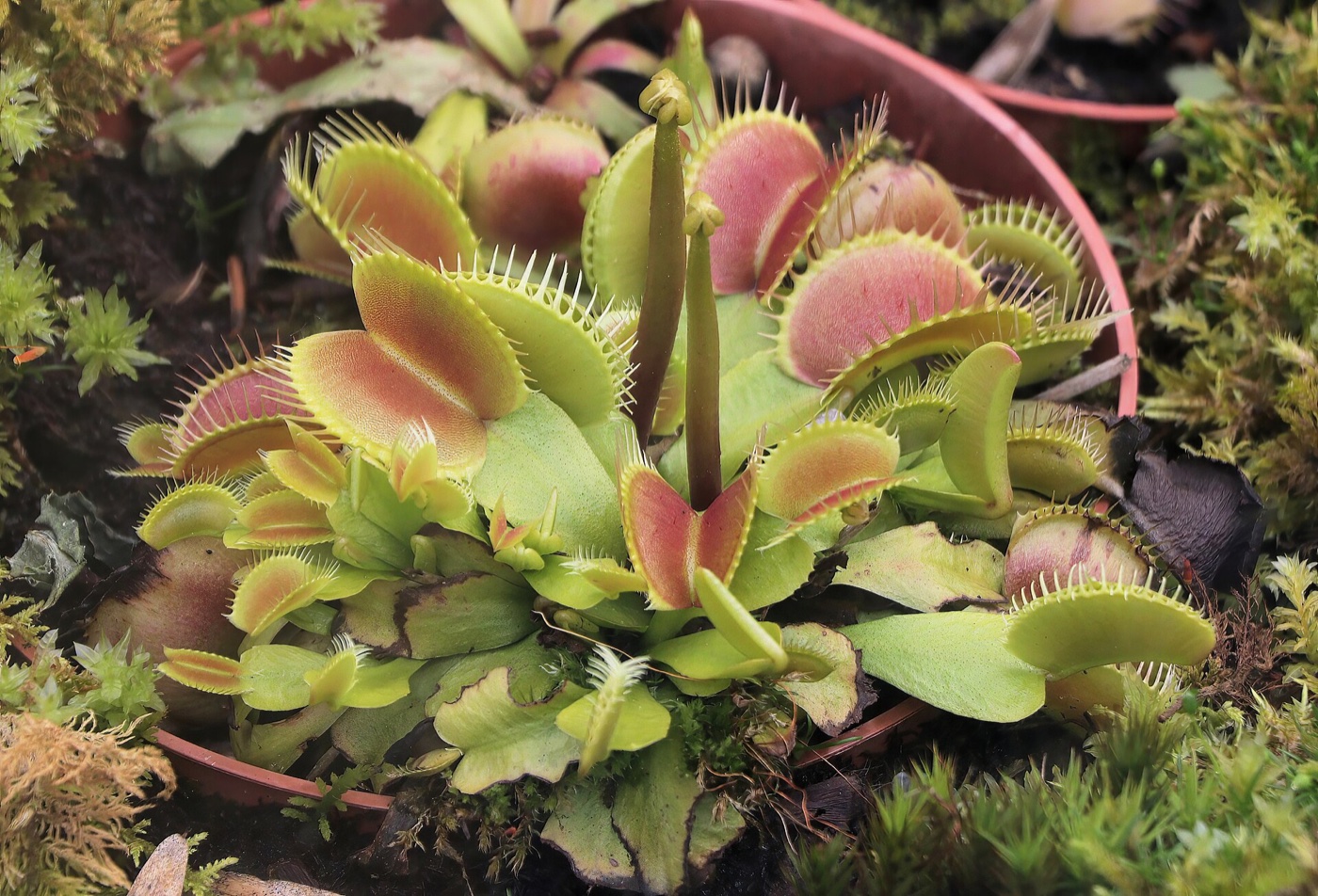
Propagating Venus flytraps (Dionaea): from seed, division of clumps, leaf pullings and cut flower stalks. Commercial stock comes from tissue culture.
The Venus flytrap is one of the easiest carnivorous plants to multiply at home. Mature plants clump and can simply be divided when repotted at the end of dormancy, which is the method to try first. Leaf pullings taken in spring are almost as reliable and give many plants from one, and a flower stalk you were going to cut off anyway can be laid on peat to root. Seed is straightforward but slow, and the tissue culture behind commercial stock is a project for growers who enjoy sterile technique.
Seed
Moderate
When: Pollinate in spring as the flowers open; sow as soon as the capsules ripen, about six weeks later.
Hand-pollinate, collect the small black seed when the capsule dries, and sow it straight away on the surface of a peat and sand mix under humid cover. Seedlings need several years to reach trap-catching size.
- Each flower stays open for only a few days. The anthers release pollen as soon as the flower opens, but the stigma is not receptive until two or three days later, when its surface looks fuzzy.
- Move yellow pollen onto a receptive stigma with a fine brush, or simply press two open flowers together.
- Capsules take roughly six weeks to ripen. Collect the shiny black seed and sow it at once, or store it dry in the refrigerator.
- Scatter the seed thinly on the surface of the usual mix. An optional 1 to 3 mm layer of washed sand over the top helps hold moisture.
- Enclose the pot in a clear bag or dome, keep it at 20 to 25 C (70 to 80 F) in bright light, and keep the mix saturated with pure water.
- Prick seedlings out into their own pots at about one year old.
- Medium
- 1:1 peat and sand, or 4:1 peat and perlite, with an optional thin cap of washed sand.
- Conditions
- Bright light, 20 to 25 C, high humidity until germination.
- Time to result
- Germination in a few weeks. Mature plants in two to three years if the seedlings are fed and kept warm and bright; closer to five years without feeding.
Watch out for
- Seedlings often stall after about four months as if preparing for winter; warmth, strong light and regular feeding keep them moving.
- Seed loses vigour in storage; fresh seed germinates best.
Sources for this method
- Peter D'Amato, The Savage Garden, Revised Edition (Ten Speed Press, 2013), The Venus Flytrap chapter, propagation section. ISBN 978-1-60774-410-8
- ICPS: Growing Dionaea muscipula (accessed )
Division
Easy
When: Late winter to early summer, most conveniently while repotting at the end of dormancy.
Established plants form clumps through offshoots from the rhizome. Unpot the clump, separate the crowns where they join, and pot each piece that has its own roots.
- Unpot the plant and rinse the mix away so the rhizomes and growing points are visible.
- Work the crowns apart at the junctions; snap or cut where necessary. Discard any black, rotten rhizome.
- Pot each crown with roots at the same depth as before, in fresh mix, and return it to the water tray.
- Medium
- Fresh 1:1 peat and sand or 4:1 peat and perlite.
- Conditions
- Normal growing conditions; shade from strong sun for a week or two.
- Time to result
- Divisions grow on without a check when taken while dormant.
Watch out for
- A crown without roots will struggle; treat it like a leaf pulling instead.
- Bare-rooting in full growth sets plants back for a season.
Sources for this method
- Peter D'Amato, The Savage Garden, Revised Edition (Ten Speed Press, 2013), The Venus Flytrap chapter, propagation section. ISBN 978-1-60774-410-8
- ICPS: Growing Dionaea muscipula (accessed )
Leaf cuttings
Easy
When: Spring or early summer, when the plant is in active growth.
Pull a whole leaf away from the rhizome so that its pale base comes with it, lay it on damp mix under cover, and plantlets form at the base within weeks. Known to growers as leaf pullings.
- Hold the leaf near its base and pull it down and outward so it detaches with the whitish tissue that joined it to the rhizome.
- Trim off the trap and any blackened tissue; only the base matters.
- Lay the leaf face up on damp peat and sand or milled sphagnum, and cover the base lightly with mix. Some growers push the base just under a layer of sand instead.
- Enclose the pot in a bag or propagator, keep it damp and bright, and remove any leaf that rots.
- Separate the plantlets once they have several leaves and roots of their own, usually after a few months.
- Medium
- Peat and sand, or long-fibre or milled sphagnum.
- Conditions
- High humidity, bright but not scorching light, warm room temperature.
- Time to result
- Plantlets at the base in a few weeks; separate at about five months; flowering-size plants in roughly two years.
Watch out for
- A leaf that snaps off without the white base almost never produces plantlets.
- Ordinary potting compost or salty perlite kills pullings; use washed sand and peat.
Sources for this method
- Peter D'Amato, The Savage Garden, Revised Edition (Ten Speed Press, 2013), The Venus Flytrap chapter, propagation section. ISBN 978-1-60774-410-8
- ICPS: Dionaea Leaf Pullings Step-by-Step (accessed )
Flower-stalk cuttings
Easy
When: Spring, when the flower stalk is still short.
A flower stalk cut while young can be laid on damp peat, where it produces plantlets at the nodes. Useful for growers who remove flower stalks anyway to spare the plant.
- Cut the stalk when it is about 7.5 cm (3 in) tall and remove any flower buds.
- Lay it on damp peat or sphagnum with the cut ends lightly covered, or push short sections upright into the mix.
- Keep it humid and bright under a bag or dome.
- Pot the plantlets once they have roots.
- Medium
- Peat, or long-fibre sphagnum.
- Conditions
- High humidity, bright light.
- Time to result
- Plantlets in several weeks.
Watch out for
- A stalk that has been allowed to grow tall or set seed has little reserve left and rarely roots.
- The exposed part of the stalk usually dies back; the plantlets form at the buried nodes.
Sources for this method
- Peter D'Amato, The Savage Garden, Revised Edition (Ten Speed Press, 2013), The Venus Flytrap chapter, propagation section. ISBN 978-1-60774-410-8
Tissue culture
Difficult
When: Any time explant material is available; flower stalks in spring are a convenient source.
Nearly all flytraps sold commercially come from sterile culture. Seed, young leaves, flower buds and sections of flower stalk all work as starting material, but the method needs sterile technique and a gelled nutrient medium.
- Prepare a half-strength MS medium with sugar and agar in sealed jars, and sterilise jars and tools in a pressure cooker.
- Cut explants (flower stalk sections, young leaves, buds or seed), surface-sterilise them in alcohol, dilute bleach and peroxide, rinse in sterile water and place them on the medium inside a clean box.
- Keep the jars under lights on a long day. New growth appears in roughly four to eight weeks and can be divided and recultured or moved to soil and hardened off under cover.
- Medium
- Gelled MS-based culture medium.
- Conditions
- Sterile, sealed, under fluorescent or LED light about 25 to 30 cm away.
- Time to result
- Visible growth in four to eight weeks; dozens of plantlets per explant within a few months.
Watch out for
- Contamination by mould or bacteria is the usual failure; discard affected jars.
- Culture hormones can induce mutations; many of the odd flytrap cultivars arose this way.
Sources for this method
- Peter D'Amato, The Savage Garden, Revised Edition (Ten Speed Press, 2013), The Venus Flytrap chapter, propagation section and cultivar notes. ISBN 978-1-60774-410-8
- ICPS: Growing Dionaea muscipula (accessed )
- Conner, D. (2006). Propagating Dionaea by tissue culture using flower stalks. Carnivorous Plant Newsletter 35(3): 79-83 (accessed )
Sources
References for the facts on this page.
- Peter D'Amato, The Savage Garden, Revised Edition (Ten Speed Press, 2013), The Venus Flytrap chapter. ISBN 978-1-60774-410-8