Propagation
Propagating Drosera
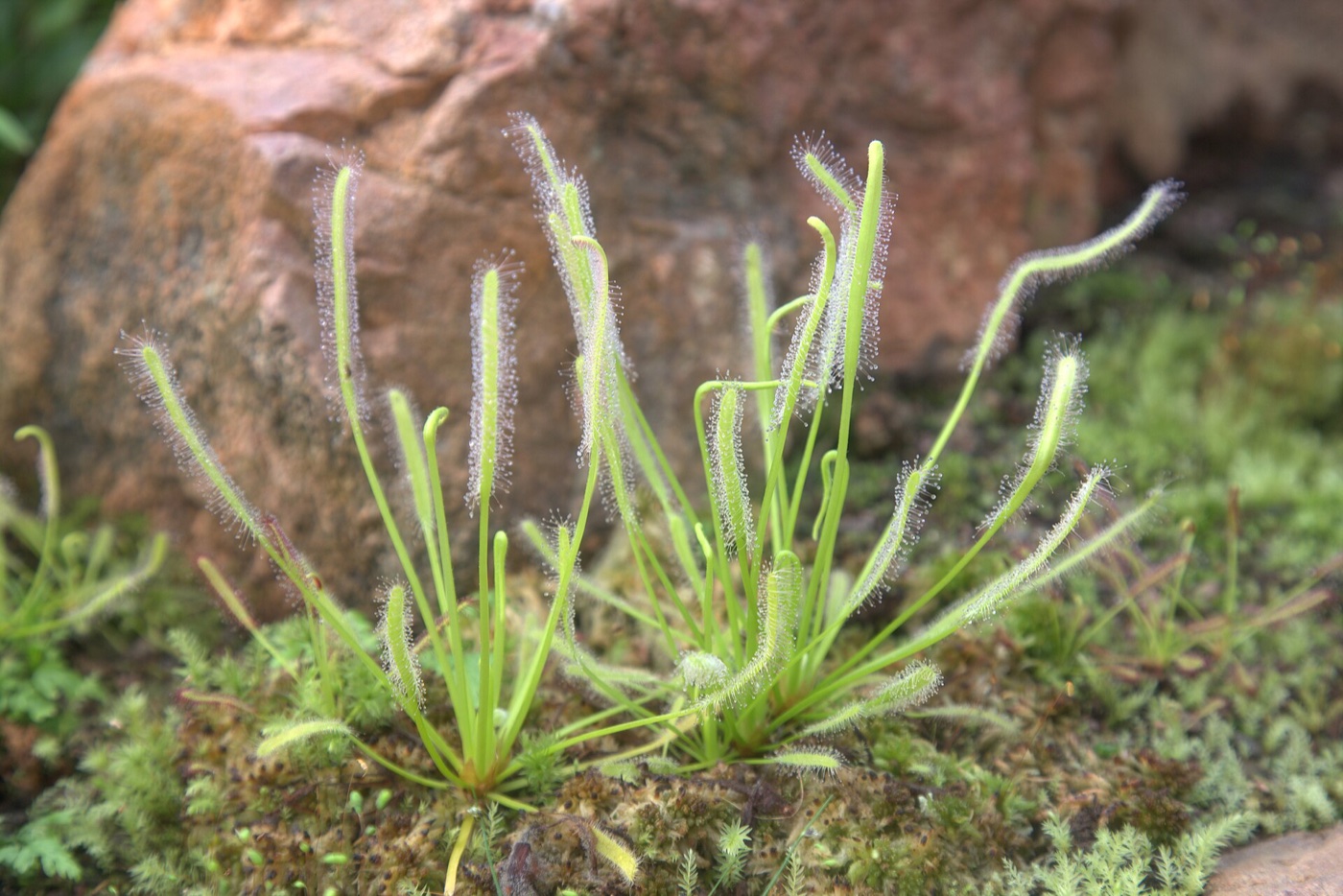
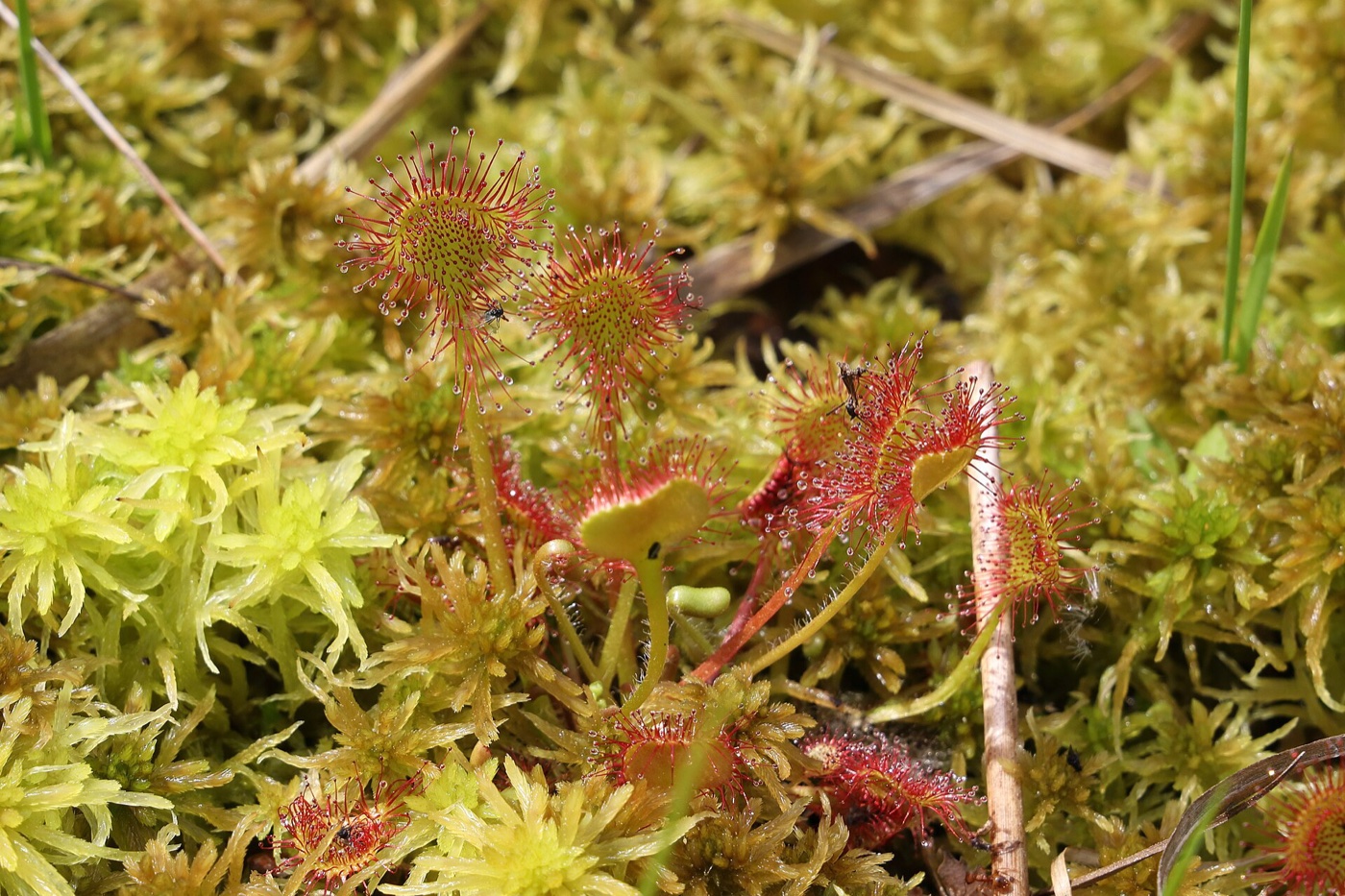
Propagating Drosera, the sundews: the easiest carnivorous plants to multiply. Most sow themselves and nearly all grow from leaf cuttings.
No carnivorous genus is easier to multiply than the sundews, but the right method depends on the group. The everyday species, D. capensis and the rosetted subtropicals, seed themselves and strike from leaf or root cuttings, and a leaf cutting floated in a cup of pure water is the method to try first. Temperate species need a damp cold spell before their seed will germinate and are best divided while dormant. Pygmies are grown almost entirely from the gemmae they produce each autumn, and the tuberous species from daughter tubers separated during their dry summer rest. Whatever the method, use pure water, keep the cuttings humid, and expect to wait a month before anything shows.
Seed
Easy
When: Sow most species in late winter or early spring. Sow winter-growing tuberous and South African species in early summer onto dry medium and wet it in autumn. Temperate species need a damp cold spell first.
Many sundews self-pollinate as the flower closes and shed abundant seed. Collect it when the pods brown, store it cold, sow it thinly on the surface of the usual mix and keep it humid and bright. Temperate species need a few weeks of damp cold before they will germinate; tuberous species need warm, dry storage in the pot instead.
- Tease open flowers with a toothpick or brush to improve seed set. Self-pollinating groups include D. capensis, most rosetted subtropicals, D. hookeri and a few other tuberous species; most pygmies, tuberous species, fork-leaved sundews and the Queensland species need pollen from a different clone, and sterile hybrids never seed.
- Pods ripen over several weeks. Shake the seed out, keep it in a small airtight bag or envelope in the refrigerator, and sow within the year.
- Sow thinly on the surface of the species' usual mix, about 2.5 to 5 cm deep in the pot. Do not cover. Bag the pot or cover the tray for humidity.
- Cold-temperate species (D. rotundifolia, D. anglica, D. intermedia, D. filiformis): either sow outdoors in autumn or mix the seed into damp chopped sphagnum in a bag and refrigerate at 1 to 4 C for about 4 weeks (6 to 8 weeks for D. linearis), then spread the moss on the surface.
- Winter-growing tuberous species: sow on dry mix by early August in the northern hemisphere, keep warm and dry for a couple of months, then stand the pot in water as temperatures fall; expect germination in October or November. Species such as D. hookeri, D. auriculata and D. macrantha will also germinate without the warm spell if sown by early September.
- Give bright light or grow lights without hot sun. Remove covers once seedlings show, and prick out with forceps when large enough to handle.
- Medium
- 3 parts peat to 1 part sand or perlite for most; 1:1 peat and sand for temperate species; 1:2 peat and sand in deep pots for tuberous species; sand and chopped sphagnum for D. regia.
- Conditions
- Humid and bright, out of direct sun. Subtropical and pygmy species germinate best at 20 to 25 C; the woolly (petiolaris) species at 25 to 32 C; temperate species after cold; tuberous species in cool autumn conditions.
- Time to result
- Germination usually in 4 to 8 weeks for subtropical species, a few weeks for D. regia, three weeks or so after stratification for temperate species; some seed takes months. Flowering-size plants in one to two years.
Watch out for
- Damping-off and moss overgrowth kill crowded seedlings; sow thinly and transplant if moss takes over.
- D. capensis and D. spatulata seed themselves into every pot in a collection; cut their scapes if you do not want seedlings.
- Cold stratification does not work for tuberous species, despite occasional advice that a light frost helps; they need a warm dry period in summer instead.
- Seed of registered cultivars such as D. 'California Sunset' should be discarded; propagate those only vegetatively.
Sources for this method
- Peter D'Amato, The Savage Garden, Revised Edition (Ten Speed Press, 2013), The Sundews chapter, propagation section. ISBN 978-1-60774-410-8
- Growing cold temperate Drosera (International Carnivorous Plant Society) (accessed )
- Growing tuberous Drosera (International Carnivorous Plant Society) (accessed )
- Growing Subtropical Drosera (International Carnivorous Plant Society) (accessed )
- Sowing Carnivorous Plant Seeds Step-by-Step (International Carnivorous Plant Society) (accessed )
Leaf cuttings
Easy
When: Start of the growing season, using fresh fully open leaves.
Applies to: Nearly all species. Poor or useless for D. regia (use roots), D. burmannii (an annual, use seed), pygmies (use gemmae) and most tuberous species, which have too few leaves and too short a season.
Cut a healthy dewy leaf at the petiole and either lay it tentacle side up on wet medium under cover or float it in a sealed container of pure water. Plantlets sprout from the leaf surface after a month or more.
- Pick the best three or four fully open leaves from a vigorous plant and cut each at the non-sticky part of the petiole. For woolly (petiolaris) sundews pull the whole petiole away with its base, as plantlets form only there.
- Cut long leaves of D. filiformis and the fork-leaved sundews into pieces about 5 cm long; wide leaves can be slit lengthwise for more plantlets.
- Water method: float the pieces tentacle side up in about a centimetre of distilled or reverse-osmosis water in a covered cup or dish. Change the water weekly or as soon as it clouds.
- Medium method: lay the pieces flat, tentacles up, on wet peat and sand or sphagnum, and hold the ends down with pinches of medium. Cover for near-100 percent humidity and press any leaf that lifts back into contact.
- Keep in very bright indirect light or under grow lights, no closer than about 30 cm to fluorescent tubes. Pot plantlets on once they have a few leaves, burying them very slightly in sand.
- Medium
- Pure water in a sealed container, or wet peat and sand, long-fibre or milled sphagnum.
- Conditions
- Covered, humid, bright indirect light at the parent's growing temperature; the tropical petiolaris species need warmth.
- Time to result
- Little happens in the first month. D. filiformis and D. binata may show plantlets in the second month; slow species such as D. slackii can take five months.
Watch out for
- Leaves that go completely brown or grow mould should be removed; do not give up on a leaf while any green or red remains.
- Cuttings on medium pick up mould, cyanobacteria and moss spores and shift out of contact; the water method is cleaner, and D. regia leaves rot on soil but can sprout in water.
- Few plantlets from most species, and they grow slowly; this is a numbers game.
Sources for this method
- Peter D'Amato, The Savage Garden, Revised Edition (Ten Speed Press, 2013), The Sundews chapter, propagation section. ISBN 978-1-60774-410-8
- Drosera Leaf Cuttings (International Carnivorous Plant Society) (accessed )
Root cuttings
Easy
When: Early in the growing season or at the end of dormancy, usually at repotting.
Applies to: Thick-rooted species: D. capensis, the fork-leaved sundews, D. regia, D. adelae and its relatives, and most rosetted subtropicals such as D. aliciae and D. slackii.
Cut pieces of the thick black roots about 5 cm long, lay them horizontally on medium under a very thin covering, and keep them humid and bright. Shoots appear in several weeks and the plants can reach maturity in a single season.
- At repotting, or by working from the drainage holes of a pot you would rather not disturb, remove a few of the older roots; they are black with pale tips.
- Cut them into pieces 2 to 5 cm long.
- Lay the pieces flat on about 5 cm of medium and cover with no more than 1 cm, or float them over wet sphagnum in a covered clear container.
- Cover for humidity and give bright light. Pot on once the plantlets have a few leaves 2 to 3 cm long, after a few months.
- Medium
- Long-fibre sphagnum, or peat with sand or perlite.
- Conditions
- Covered, humid, bright indirect light.
- Time to result
- Shoots in several weeks; mature plants within a season for vigorous species.
Watch out for
- Pieces buried deeply rot before they sprout; keep the covering shallow.
- D. regia resents disturbance, so take roots from the base of the pot rather than unpotting a large plant.
Sources for this method
- Peter D'Amato, The Savage Garden, Revised Edition (Ten Speed Press, 2013), The Sundews chapter, propagation section. ISBN 978-1-60774-410-8
- Growing Drosera regia (International Carnivorous Plant Society) (accessed )
- Growing Subtropical Drosera (International Carnivorous Plant Society) (accessed )
- Growing Drosera adelae and Sisters (International Carnivorous Plant Society) (accessed )
Division
Easy
When: While dormant for temperate species; at the start of growth for the rest.
Applies to: Clump-forming species: D. filiformis, woolly (petiolaris) sundews, D. aliciae, D. slackii, D. regia, the Queensland species that sprout from spreading roots, and D. prolifera, whose creeping flower stalks root a plantlet at the tip.
Species that form crowded clumps, or that throw plantlets from their roots or flower stalks, can simply be pulled apart at repotting and the pieces potted separately.
- Tip the clump out and separate crowns by hand, keeping some root with each; temperate hibernacula come apart cleanly while dormant.
- For D. adelae and D. schizandra, lift the plantlets that appear from the spreading roots. For D. prolifera, keep a spare pot alongside so the creeping flower stalks root into it, then cut the stalk once the plantlet is established.
- Pot each division in fresh mix and keep it humid until growth resumes. Sterile hybrids such as D. x obovata, D. x beleziana and D. x hybrida can only be increased this way or by leaf cuttings.
- Medium
- The species' usual mix.
- Conditions
- As for the parent.
- Time to result
- Divisions are established plants from the start.
Watch out for
- Dividing a plant in full growth damages roots; wait for dormancy or the start of the season.
Sources for this method
- Peter D'Amato, The Savage Garden, Revised Edition (Ten Speed Press, 2013), The Sundews chapter, species accounts and propagation section. ISBN 978-1-60774-410-8
- Growing Drosera adelae and Sisters (International Carnivorous Plant Society) (accessed )
- Growing the Drosera petiolaris complex sundews (International Carnivorous Plant Society) (accessed )
- Growing cold temperate Drosera (International Carnivorous Plant Society) (accessed )
Gemmae
Easy
When: Late autumn to early winter, as days shorten; plant them within a month of their appearing.
Applies to: Pygmy sundews (D. pulchella, D. scorpioides, D. nitidula x pulchella and the rest of the Western Australian pygmies).
Each autumn pygmy sundews produce a crown of tiny brood bodies that are flung off by raindrops. Knock or comb them off into a scoop, set each one on the soil surface at least 1 cm from its neighbours, and they root within weeks and are mature by spring.
- Give the plants a natural, shortening photoperiod in autumn; under constant light they will not form gemmae.
- Take the pot out of its tray for a few hours so the surface is not sodden, then tip it on its side over paper or a scoop and tease the gemmae crowns with a toothpick or forceps so the ripe ones spring out. Work away from other pots, because they scatter.
- Place each gemma on the surface of a tall pot of sandy mix at least 1 cm apart, with the plants' adult size in mind, since pygmies cannot be moved later. A moistened fingertip or wet brush picks them up easily.
- Mist lightly to settle them, or sprinkle a thin layer of sand over them to hold them in place, and keep humid for the first few weeks.
- Medium
- 1:1 peat and sand, or peat with 50 to 75 percent sand or perlite, in pots at least 10 cm deep.
- Conditions
- Bright, humid, cool to mild; outdoors or on a sunny sill.
- Time to result
- Roots into the soil within a few weeks; near-mature plants by spring.
Watch out for
- Gemmae stay viable for only about a month and die quickly if they dry out; plant or post them promptly, wrapped in damp paper.
- Pygmies have a single long root and almost never survive transplanting, so sow them where they will live.
- Plants kept in a terrarium under fixed lighting usually produce no gemmae.
Sources for this method
- Peter D'Amato, The Savage Garden, Revised Edition (Ten Speed Press, 2013), The Sundews chapter, pygmy sundews and propagation sections. ISBN 978-1-60774-410-8
- Pygmy Drosera Gemmae Step-by-Step (International Carnivorous Plant Society) (accessed )
- Growing pygmy Drosera (International Carnivorous Plant Society) (accessed )
Tubers
Moderate
When: Lift and separate during summer dormancy, about a month after the foliage dies back; replant at the original depth and keep dry until autumn growth.
Applies to: Tuberous sundews of Western Australia (D. hookeri, D. gigantea, D. macrantha, D. stolonifera, D. erythrorhiza and others).
These winter growers store themselves as underground tubers through the dry summer and many form daughter tubers on stolons. Separate the tubers while dormant, pot each one eye-up 5 to 10 cm deep in sandy mix, and keep the pot dry until the new stolon reaches the surface.
- Let the plants finish their 5 to 6 month season and die back naturally; do not force dormancy before they have grown that long. Remove the pot from its water tray and let the soil dry out completely, shaded from direct sun.
- About a month after die-back, sift the dry mix and pick out the tubers, which range from pinhead to walnut size and are often orange or red with a papery coat and an eye on top. Separate daughter tubers from the parent.
- Plant each tuber eye upward, 5 to 10 cm deep, or at the depth it came from, in pre-wetted 2:1 sand and peat in a deep drained pot of 12 to 20 cm; backfill the hole loosely with pure sand.
- Keep the pot dry and out of sun through summer. Once the stolon shows at the surface in autumn, water from above and stand the pot in about 2.5 cm of water for the season at 4 to 24 C.
- Purchased dry tubers can be kept in an airtight bag with barely damp sphagnum in the dark at room temperature, checked weekly, and potted as soon as the stolon emerges.
- Medium
- 2 parts sand to 1 part peat, or at least 1:1; long-fibre sphagnum for a few species.
- Conditions
- Cool, bright winter growth (4 to 10 C minimum, 16 to 24 C maximum); warm, dry, dark dormancy.
- Time to result
- Shoots in autumn; flowering plants in the first or second season; tubers enlarge and multiply yearly, so repot about every three years.
Watch out for
- Tubers left wet in dormancy rot; tubers left in a sun-baked pot shrivel. The exceptions are D. gigantea and D. sulfurea, which must never dry out completely, and D. whittakeri, which is kept slightly damp.
- Plants in growth have long fragile roots and cannot be moved; the dormant tuber is the only stage that travels.
- Do not wait until autumn to repot: some species start their stolon just below the surface in late summer.
- Imported Australian tubers arrive out of season and grow for only about three months in their first northern summer before falling into step.
Sources for this method
- Peter D'Amato, The Savage Garden, Revised Edition (Ten Speed Press, 2013), The Sundews chapter, tuberous sundews and propagation sections. ISBN 978-1-60774-410-8
- Growing tuberous Drosera (International Carnivorous Plant Society) (accessed )
- Tuberous Drosera: Care and Cultivation (New England Carnivorous Plant Society) (accessed )
Tissue culture
Difficult
When: Fresh seed, surface-sterilised and sown into sterile culture.
Most sundews start readily in sterile culture from surface-sterilised seed and multiply quickly on dilute nutrient gel. It is how nurseries produce clones in quantity, but it needs a sterile workspace and prepared media, so it is a project rather than a kitchen method.
- Surface-sterilise seed (dilute bleach followed by sterile rinses is the usual approach) and sow it on a sterile gel medium in sealed vessels under lights.
- Divide the resulting rosettes onto fresh medium every couple of months. For D. intermedia, one-eighth strength Murashige and Skoog salts gives taller plants and more shoots than full strength, and most added hormones suppress multiplication.
- Wean rooted plantlets out of the flask into peat and sand under a cover, lowering the humidity over several weeks.
- Medium
- Sterile agar media with dilute mineral salts.
- Conditions
- Sterile flasks under lights; weaned plants under humid cover.
- Time to result
- Months in culture; plants of potting size within a year.
Watch out for
- Contamination is the usual failure; over-harsh sterilisation kills the seed.
Sources for this method
- Peter D'Amato, The Savage Garden, Revised Edition (Ten Speed Press, 2013), The Sundews chapter, propagation section. ISBN 978-1-60774-410-8
- Rejthar, J., Viehmannova, I., Hlasna Cepkova, P., Fernandez, E. and Milella, L. 2014. In vitro propagation of Drosera intermedia as influenced by cytokinins, pH, sucrose, and nutrient concentration. Emirates Journal of Food and Agriculture 26(6): 558-564 (accessed )
Sources
References for the facts on this page.
- Peter D'Amato, The Savage Garden, Revised Edition (Ten Speed Press, 2013), The Sundews chapter. ISBN 978-1-60774-410-8
- International Carnivorous Plant Society growing guides and propagation pages for Drosera (accessed )