Propagation
Propagating Utricularia
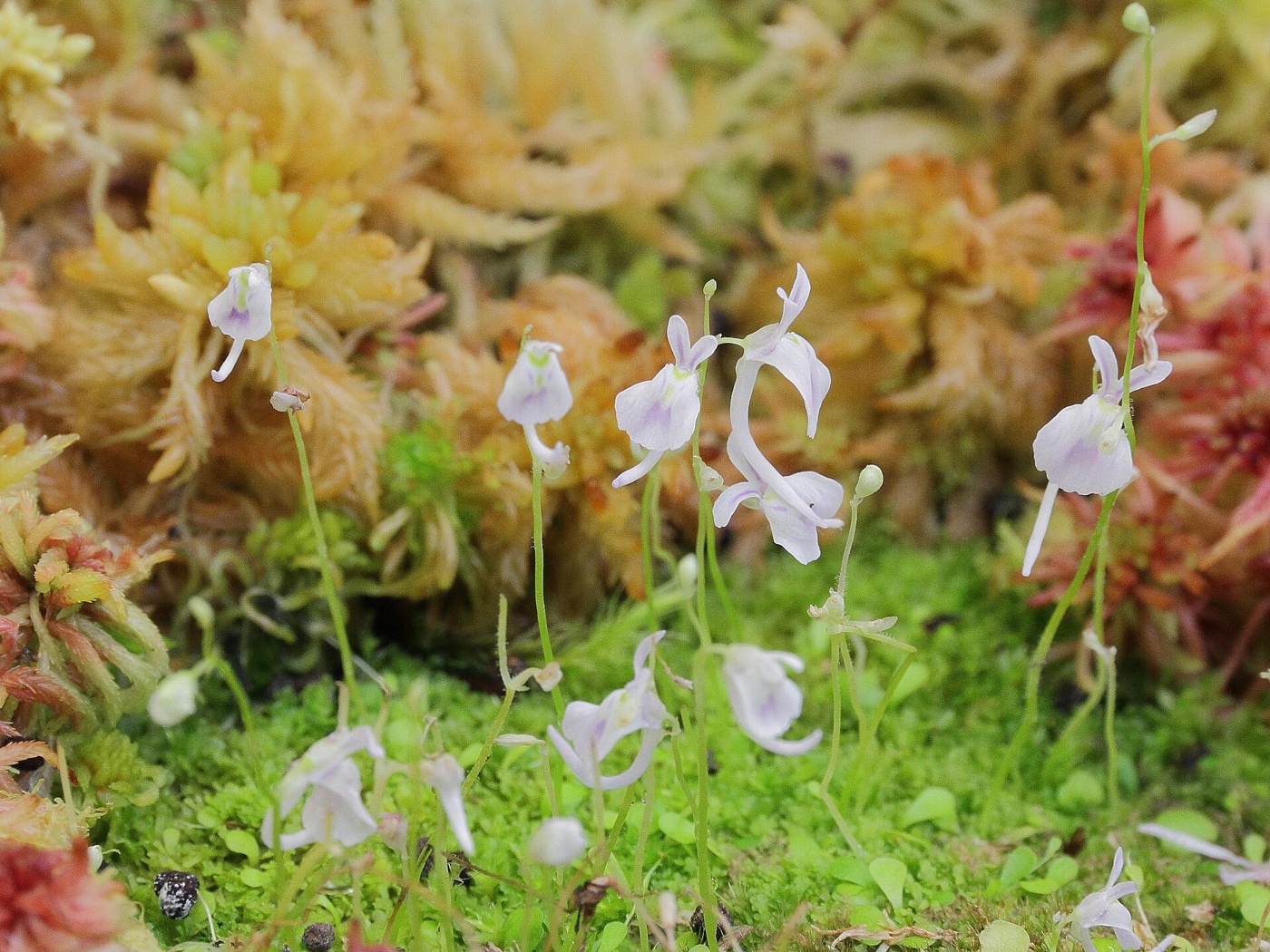
Propagating Utricularia, the bladderworts: mostly by division, using soil plugs for terrestrials, stolon pieces for epiphytes and stem lengths for aquatics.
Bladderworts have no roots and most of the plant is a web of thread-like stems below the soil or water, so almost any piece of an established colony will grow. Division is the method to try first: a plug of soil for terrestrials, a leafy stolon with a tuber for epiphytes, a length of stem for aquatics. Seed is worth the trouble only for annuals, for species that will not divide, and for the few with seed that dies within hours of ripening. Whatever you do, use pure water and keep the medium wet.
Division
Easy
When: Start of the growing season, which for most terrestrials is spring; for winter-growing or tuberous species, as growth resumes.
Applies to: Terrestrial and epiphytic species. Aquatic species are covered under fragmentation.
Bladderworts have no roots, only creeping stems that run through the medium, so any plug of soil that contains them will grow on. Cut out a piece, set it in fresh mix at the same level, and keep it wet.
- For terrestrials, cut a plug of medium about 2.5 to 5 cm square with some surface stolons attached and press it into fresh mix. Alternatively, take out half the contents of a crowded pot and refill with new mix: both halves regrow.
- For epiphytes, take a section that includes some of the larger leaf-like stolons; where the species forms small tubers, include one, as pieces with a tuber recover and grow faster.
- Water in with pure water and keep the surface wet, or for terrestrials slightly flooded, until new stolons appear.
- Restart terrestrial colonies every two or three years; they exhaust a pot and can die out if left alone.
- Medium
- Terrestrials: 3 parts peat to 1 part sand or perlite, or 1:1 peat and sand, or pure sphagnum. Epiphytes: equal parts fine orchid bark, long-fibre sphagnum, peat and perlite, or sphagnum, perlite and pumice.
- Conditions
- Bright light to part sun, pure water, surface kept wet; terrestrials in undrained bowls do well with the water level at or just above the surface.
- Time to result
- New stolons within weeks; a full carpet in a season.
Watch out for
- Weedy species such as U. subulata and U. bisquamata spread into neighbouring pots and are hard to remove; keep them apart.
- Fertiliser in the soil kills terrestrial species; feed only by very weak foliar mist, if at all.
Sources for this method
- Peter D'Amato, The Savage Garden, Revised Edition (Ten Speed Press, 2013), The Bladderworts chapter, propagation section. ISBN 978-1-60774-410-8
- Growing Genlisea and terrestrial Utricularia (International Carnivorous Plant Society) (accessed )
- Growing epiphytic Utricularia (International Carnivorous Plant Society) (accessed )
- Utricularia (NC State Extension Plant Toolbox) (accessed )
Fragmentation
Easy
When: Any time the plants are in active growth; spring is best for temperate species emerging from turions.
Applies to: Aquatic species such as U. gibba, U. vulgaris, U. macrorhiza and U. inflata.
Aquatic bladderworts are floating stems with no roots. Cut off a piece a few centimetres long, drop it into suitable water, and it grows into a new plant.
- Snip a length of healthy stem, about 7.5 cm; pieces as short as 1 cm survive and branch, so size is not critical.
- Float it in a container of soft, slightly acidic, peat-stained water: about a cup of peat per 4 litres, mixed in and allowed to settle before the plants go in.
- Give full to part sun and add water fleas or other pond microfauna as food and to keep algae down.
- Temperate species form turions (dense winter buds) as water cools in autumn. Leave them in the pond, or collect them and store them in a jar of the same water in a refrigerator until spring, when they resume growth within days of warming.
- Medium
- Still, shallow, acidic, nutrient-poor water with a little peat; small species in about 4 litres, large species in a tub of 190 litres or more.
- Conditions
- Full to part sun; never use algaecides, change the water instead.
- Time to result
- New branches within weeks; a tenfold increase in a season for vigorous species.
Watch out for
- Algae are the main cause of failure; shade the water surface with companion plants, add Daphnia, and change the water when it fouls.
- Some aquatics are listed as invasive weeds; U. inflata is a noxious weed in Washington State and cannot legally be sold or moved there. Check local rules before trading aquatic species.
Sources for this method
- Peter D'Amato, The Savage Garden, Revised Edition (Ten Speed Press, 2013), The Bladderworts chapter, propagation and cultivation sections. ISBN 978-1-60774-410-8
- Plant Propagation Protocol for Utricularia inflata (University of Washington, ESRM 412 Native Plant Production) (accessed )
- Utricularia (NC State Extension Plant Toolbox) (accessed )
Leaf cuttings
Easy
When: Growing season.
Applies to: Species with large leaf-like stolons, chiefly the epiphytes (U. longifolia, U. alpina, U. reniformis) and larger terrestrials such as U. praelonga.
The leaf-like organs of bladderworts are really photosynthetic stolons, and a piece of one laid on wet medium will sprout. Treat them like Drosera leaf cuttings.
- Pull or cut a healthy leafy stolon at its base; long leaves such as those of U. longifolia can be cut into pieces 2.5 to 5 cm long.
- Lay the pieces on the surface of wet medium, or float them on pure water, under humid cover in bright indirect light.
- Pot on when a tuft of new stolons has formed.
- Medium
- Live or long-fibre sphagnum, or the species' usual mix, kept wet.
- Conditions
- Humid cover, bright indirect light, warm.
- Time to result
- New growth within several weeks.
Watch out for
- Pieces that dry out die; keep the medium saturated.
Sources for this method
- Peter D'Amato, The Savage Garden, Revised Edition (Ten Speed Press, 2013), The Bladderworts chapter, propagation section. ISBN 978-1-60774-410-8
- Growing epiphytic Utricularia (International Carnivorous Plant Society) (accessed )
Tubers
Moderate
When: During dormancy, when the foliage has died back; replant as the resting period ends.
Applies to: Epiphytic and seasonal species that rest as small tubers, including U. reniformis, U. alpina and U. menziesii.
Several epiphytic and drought-adapted species die back to small tubers each year. Dormant tubers can be separated at repotting and potted up singly, and a division that carries a tuber establishes much faster than one without.
- When the leaves have withered, tip the pot out and pick the small, opaque tubers from the medium.
- Pot each one, or each cluster, just below the surface of fresh epiphyte mix.
- Keep U. reniformis barely damp and U. alpina dry until new stolons show, then return to normal watering.
- Medium
- Equal parts fine orchid bark, long-fibre sphagnum, peat and perlite.
- Conditions
- Cool to warm, humid; dormant tubers kept nearly dry.
- Time to result
- New stolons as the growing season resumes; flowering-size plants the same year for vigorous species.
Watch out for
- Tubers kept wet through dormancy rot; tubers left bone dry for too long shrivel.
- Not every epiphyte needs a rest; U. longifolia is often grown without one, though a dry winter is sometimes recommended.
Sources for this method
- Peter D'Amato, The Savage Garden, Revised Edition (Ten Speed Press, 2013), The Bladderworts chapter, epiphytic and seasonal species sections. ISBN 978-1-60774-410-8
- Growing epiphytic Utricularia (International Carnivorous Plant Society) (accessed )
Seed
Moderate
When: Pollinate as flowers open; sow at the start of the growing season, or at once for species whose seed does not keep.
Most species need hand pollination, done as for Pinguicula with a toothpick or a needle for the tiniest flowers. Sow on the surface of wet medium and keep the pot in a bag with a little water in the bottom.
- Push a toothpick (a needle for very small flowers) into the spur and throat, sweep upward on withdrawal, and repeat several times on the same flower.
- Collect seed when the capsule browns. Sow it on the surface of the usual medium, wet to very wet, and stand the pot in a sealed bag with a few centimetres of water in the bottom, under lights but far enough away not to cook the seedlings.
- U. humboldtii seed has a visible green embryo and dies if it dries: sow it in water the day it is collected; it germinates within about a day.
- For the annual aquatic U. volubilis, sow on wet sandy peat in a large bowl and raise the water level gradually over a few weeks to about 12 cm, with twigs for the twining flower stalks.
- Move germinated pots to a terrarium; seedlings are slow at first. For annuals and short-lived species, save seed every year.
- Medium
- The species' usual mix, surface kept wet; epiphytes on a 1 cm top layer of finely chopped sphagnum and fine perlite.
- Conditions
- Warm, humid, bright; terrestrials with the water at the surface.
- Time to result
- Germination within weeks for most; a day for U. humboldtii.
Watch out for
- Self-pollinating species such as U. subulata, U. calycifida and the common form of U. bisquamata seed themselves into every nearby pot; cultivars grown together will cross.
- Some species, including U. livida and U. bisquamata 'Betty's Bay', rarely or never set seed; divide them instead.
Sources for this method
- Peter D'Amato, The Savage Garden, Revised Edition (Ten Speed Press, 2013), The Bladderworts chapter, propagation section and species accounts. ISBN 978-1-60774-410-8
- Growing Genlisea and terrestrial Utricularia (International Carnivorous Plant Society) (accessed )
- Growing epiphytic Utricularia (International Carnivorous Plant Society) (accessed )
Sources
References for the facts on this page.
- Peter D'Amato, The Savage Garden, Revised Edition (Ten Speed Press, 2013), The Bladderworts chapter. ISBN 978-1-60774-410-8
- International Carnivorous Plant Society growing guides for Utricularia (accessed )