Plant group
American pitcher plants
Sarracenia, American pitcher plants: pitfall-trap perennials, among the easiest outdoors in temperate climates given full sun, pure water and a cold winter.
SarraceniaAmerican pitcher plants · Trumpet pitchersFamily Sarraceniaceae · Eleven species; older treatments count eight
Care at a glance
BeginnerEasy in a sunny outdoor bog or on a bright patio with a cold winter; much harder on a windowsill, where only the low-growing species stand a chance.
- Where they grow
- Eastern North America: wet pine savannas and bogs of the southeastern USA coastal plain, with one species reaching across Canada.
- Trap
- Pitfall pitcher
- Light
- Full sun, six or more hours of direct light. Shade gives floppy, pale pitchers with little colour.
- Water
- Rain, distilled or reverse-osmosis water. Stand pots in 4 to 6 cm (1.5 to 2.5 in) of water through the growing season; damp in winter.
- Growing medium
- Sphagnum peat moss with washed sand, about 1:1, or long-fibre sphagnum. Deep pots for the thick rhizome and long roots.
- Temperature
- Warm summers. Cold winters: light frost suits every species; varies by species from freeze-sensitive (S. psittacina) to fully hardy under snow (S. purpurea subsp. purpurea).
- Dormancy
- Required. Three to four months of cold and short days; most species brown off, S. purpurea and its relatives keep their pitchers.
- Feeding
- The pitchers fill themselves outdoors. Indoors, a few insects per pitcher. No fertiliser.
Start with
- Sarracenia purpureaThe hardiest species, happy in a cold outdoor bog, and the easiest pitcher plant to begin with.
- Sarracenia flavaThe classic tall yellow trumpet; forgiving once it has sun and room, and the parent of many hybrids.
- Sarracenia leucophyllaWhite-topped pitchers at their best in late summer, when other species are tired; needs the most sun of all.
- A named hybrid such as Sarracenia 'Judith Hindle'Hybrids are usually more vigorous than either parent and tolerate more; this one is a sound choice for a single plant.
Watch out for
- Floppy, pale, narrow pitchers: too little light.
- No new pitchers in spring after a warm indoor winter: the plant was not allowed to rest.
- Flat, blade-like leaves with no trap in late summer or winter: phyllodia, a normal seasonal leaf on several species.
- Pitchers toppling over: full of insects, or grown in shade.
- Crown soft and brown after winter: rhizome rot from warm wet storage, fertiliser or mineral-rich water.
- Twisted, stunted new pitchers in spring: aphids; scale and mealybugs appear later in the season.
What they are
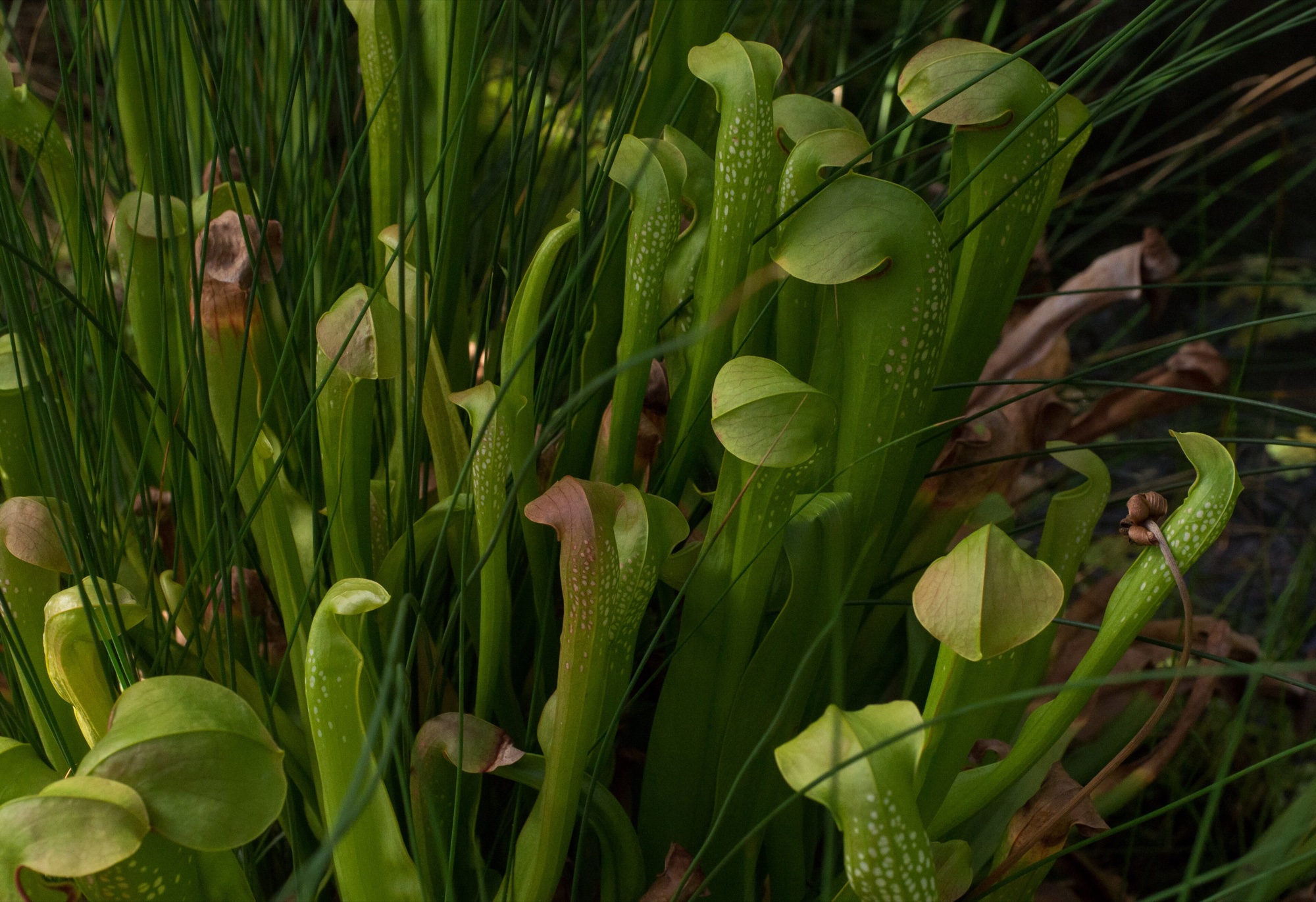
Sarracenia are perennial herbs that grow from a thick rhizome and send up leaves shaped into hollow tubes, each one a pitfall trap with no moving parts. The inside is waxy and lined with downward-pointing hairs; nectar and colour draw insects to the rim, and anything that slips in cannot climb out. In most species a hood arches over the mouth and keeps rain out; only S. purpurea and S. rosea normally hold rainwater in their open pitchers, which is how those two drown their catch.
Size varies enormously. S. psittacina sprawls on the ground with pitchers 8 to 30 cm (3 to 12 in) long, while the trumpets of S. leucophylla and S. flava stand up to 1 m (3 ft). Each growing point produces one nodding flower on a stalk in spring. The buds form in late summer and sit through winter. A capsule holds 400 to 1,000 seeds. The genus name honours Michel Sarrazin, a physician in New France who sent specimens to Europe; Linnaeus published it in 1753. The species cross freely and the hybrids are fertile, so hybrid swarms occur where species meet.
Where they grow
Most species belong to the coastal plain of the southeastern United States: wet pine savannas, seepage bogs and swamp edges, in nutrient-poor sand or peat that stays wet all year. These are open, sunny places, and they stay open only because they burn. Without frequent fire the habitat turns to thicket within years and the shaded pitcher plants weaken; a fire brings them back. Two species live in mountain seepage bogs far from the coastal plain, S. oreophila in Alabama, Georgia and North Carolina and S. jonesii in the Blue Ridge of the Carolinas; both are on the US federal endangered list, S. oreophila being the first pitcher plant listed. Only S. purpurea ranges north, through the Great Lakes and New England and across Canada to British Columbia, wintering under snow.
About 97.5 percent of pitcher plant habitat in the southeastern United States has been destroyed. Never buy a plant that might have been dug from the wild; nurseries raise all of these species from seed and division.
The range in cultivation
Older treatments count eight species. This site counts eleven: it accepts S. rosea, described in 1999 from the Gulf Coast plants formerly called S. purpurea var. burkii, and treats S. jonesii and S. alabamensis as species rather than subspecies of S. rubra. Care is the same whichever name is on the label.
- Tall trumpets. S. flava, the yellow trumpet, makes its best pitchers in spring and flat bladelike leaves called phyllodia later. S. leucophylla, the white-top, makes a weak spring flush and a splendid late-summer one. S. oreophila is a spring plant whose pitchers die back by mid July. The S. rubra group, including S. jonesii and S. alabamensis, are smaller clump-formers with fragrant red flowers.
- Squat cups. S. purpurea, in a hardy northern and a milder southern subspecies, and the pink-petalled S. rosea hold rainwater in open pitchers and keep their leaves through winter.
- Hooded. S. minor has a hood curving right over the mouth and translucent spots that lure insects inward; its flowers are the only scentless ones in the genus, it tolerates more shade than the others, and the Okefenokee form reaches 1 m (3 ft).
- Lobster pot. S. psittacina lies flat with a round, beaked head and a one-way entrance; it spends periods under water in the wild and is the only freeze-sensitive species.
- Hybrids. Any species will cross with any other and most plants sold are hybrids; old Latin names such as S. × moorei for S. flava × S. leucophylla are still used. Named cultivars are registered with the ICPS, among them ‘Judith Hindle’, a cross of S. leucophylla, S. flava var. rugelii and S. purpurea published in 1993.
Growing them
Light
Full sun, six or more hours of direct light; plants in part shade colour poorly and droop. Afternoon shade is acceptable only where summers are very hot and dry. Indoors is the difficulty: a tall trumpet cannot be lit properly, and only the low species S. psittacina and S. rosea suit year-round growing under lights. S. purpurea subsp. venosa is the best windowsill species and the trumpets the worst.
Water
Mineral-poor water only. Keep pots standing in 4 to 6 cm (1.5 to 2.5 in) of water through the growing season and never let them dry out; in a bog container the water table sits 7 to 18 cm (3 to 7 in) below the surface. Reduce to damp in winter.
Growing medium
The standard mix is sphagnum peat moss and washed sand in equal parts; perlite can replace sand outdoors where rain flushes the pots. Some clones of the northern S. purpurea and of S. minor prefer live sphagnum, and S. psittacina does best in pure peat in a short pot. Some growers prefer a heavier mix, 7 parts peat to 3 of sand or 4 to 1 with perlite, on the grounds that perlite is slightly alkaline; both grow good plants. Use deep pots. Divide and repot every three or four years in late winter.
Temperature
Summer heat is no problem with wet roots; winter cold is required, and how much each species takes varies. Most species are fully hardy in USDA zone 7, S. rosea and S. minor in zone 8, and S. psittacina as freeze-sensitive. In zone 6 the Carolina and mountain species, S. flava, S. oreophila, S. jonesii and S. purpurea subsp. purpurea, survive in a mulched bog with a row cover in freezes, and in zone 5 and colder only S. purpurea subsp. purpurea is reliable outdoors. In Britain S. purpurea is rated H6, hardy to -20 °C (-4 °F), and S. flava H3, needing protection below about -5 °C (23 °F).
Dormancy
Three to four months of cold and short days. Plants shut down on their own as autumn days shorten and restart in late winter, usually with a flower stalk. Potted plants survive a few weeks frozen solid if fully dormant and not freeze-dried, and a garage, cold frame or unheated porch works where pots cannot stay outside, provided it is cold enough not to trigger early growth. Trim only the brown parts of leaves, since cutting green ones can starve a plant with a small rhizome. The pitchers of S. purpurea, S. rosea and S. psittacina last up to two years and come off only once brown.
Feeding
Outdoors the pitchers catch more than the plant can use. Under glass or lights, drop a few insects into each pitcher during the season; for the S. purpurea group a little slurry of rehydrated bloodworm works well. Some growers use foliar fertiliser once or twice a month under glass, but mature plants gain little from fertiliser, fertiliser reaching dead tissue causes rhizome rot, and pouring fertiliser water into tall pitchers is counterproductive, so this site recommends none.
Common mistakes
- Growing them indoors or in shade and blaming the water.
- A warm winter: a plant kept growing on a heated windowsill all year has nothing left by its third spring.
- Cutting off green leaves to tidy the plant.
- Fertiliser in the pot or the pitchers.
- A small dark pot on a hot patio for the northern S. purpurea, which can be killed by an overheated pot.
Which to start with
S. purpurea is the usual starting point and the species that lives outside almost anywhere with a cold winter; its profile separates the two subspecies. S. flava is the trumpet to learn on, big, tolerant and the parent of many hybrids, with its own profile. S. leucophylla rewards a sunny spot with the best pitchers of the year in September. A vigorous named hybrid such as ‘Judith Hindle’ is a sound first plant, and a good choice for anyone limited to a single plant. Leave the endangered species and the slow, freeze-sensitive S. psittacina for later.
Going further
Once a plant has filled its pot, division gives you more; seed takes four years or more to flowering. Both are described in the propagation entry for Sarracenia. A sunny bog container with two or three species and a Venus flytrap is the classic next step. The cobra plant, Darlingtonia, is the family’s only western member and a very different proposition.
Sources
References for the facts on this page.
- Flora of North America: Sarracenia (accessed )
- Flora of North America: Sarraceniaceae (accessed )
- Flora of North America: Sarracenia rosea (accessed )
- Flora of North America: Sarracenia oreophila (accessed )
- Flora of North America: Sarracenia jonesii (accessed )
- Flora of North America: Sarracenia alabamensis (accessed )
- Flora of North America: Sarracenia leucophylla (accessed )
- Flora of North America: Sarracenia minor (accessed )
- Flora of North America: Sarracenia psittacina (accessed )
- International Carnivorous Plant Society: Growing Sarracenia (accessed )
- NC State Extension Plant Toolbox: Sarracenia flava (accessed )
- NC State Extension Plant Toolbox: Sarracenia purpurea (accessed )
- NC State Extension Plant Toolbox: Sarracenia leucophylla (accessed )
- NC State Extension Plant Toolbox: Sarracenia minor (accessed )
- NC State Extension Plant Toolbox: Sarracenia psittacina (accessed )
- NC State Extension Plant Toolbox: Sarracenia jonesii (accessed )
- RHS: Carnivorous plants growing guide (accessed )
- Royal Horticultural Society: Sarracenia purpurea (accessed )
- Royal Horticultural Society: Sarracenia flava (accessed )
- ICPS Carnivorous Plant Names Database: registered Sarracenia cultivars (accessed )
- Peter D'Amato, The Savage Garden, Revised Edition (Ten Speed Press, 2013), The American Pitcher Plants chapter. ISBN 978-1-60774-410-8