Sarracenia
Purple pitcher plant
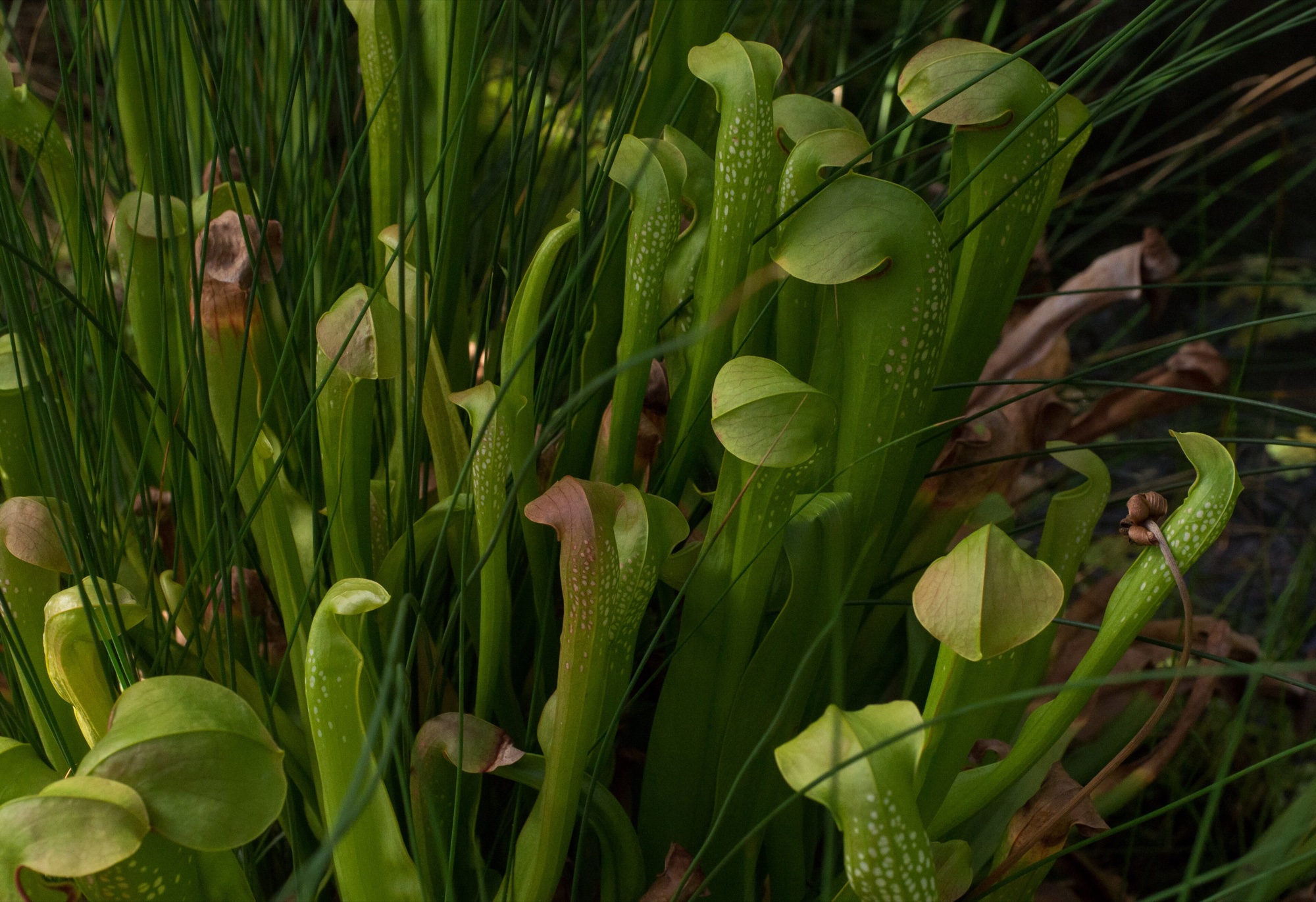
Sarracenia purpurea, the purple pitcher plant: squat and hardy, holding rainwater in open pitchers. The most cold-tolerant Sarracenia.
Sarracenia purpureaPurple pitcher plant · Northern pitcher plant · Side-saddle flowerFamily Sarraceniaceae
New to these plants? Read the Sarracenia group introduction first: it explains what the group is, where the plants grow and how the whole group is cared for.
Quick care
BeginnerDifficulty is an editorial assessment for typical home conditions, not a property of the plant.
- Native range
- Eastern North America, from the Carolinas and Georgia north through the Great Lakes and New England to much of Canada; sphagnum bogs, fens and wet savannas. Gulf Coast plants are now usually treated as Sarracenia rosea.
- Light
- Full sun. Needs direct light for most of the day to colour and to grow upright.
- Water
- Rain, distilled or reverse-osmosis water. Tray method or a bog container; keep wet in the growing season, damp in winter.
- Growing medium
- Sphagnum peat moss with perlite or sand, roughly 1:1, or long-fibre sphagnum (which suits the northern subspecies especially well).
- Temperature
- Warm summers are fine. Winter cold required; the northern subspecies tolerates hard frost and snow cover (RHS H6), the southern subspecies only light frosts (RHS H3).
- Humidity and airflow
- Not critical outdoors.
- Dormancy
- Required. Three to four months of cold, short days; pitchers persist but growth stops.
- Feeding
- Catches insects in its open pitchers. Indoor plants can be given a few small insects, or a little rehydrated bloodworm, per pitcher occasionally.
Watch out for
- Floppy, pale pitchers: too little light.
- Pitchers filling with debris and turning brown: normal ageing; trim pitchers only once they have browned.
- No new pitchers in spring after a warm indoor winter: the plant was not allowed to rest.
- Scale insects, aphids and mealybugs on new growth; slugs chewing young pitchers outdoors.
- Northern subspecies sulking in a hot summer: a small dark pot cooking in the sun; move it to a larger pot or shade the pot itself.
About this plant
Sarracenia purpurea grows as a rosette of short, fat pitchers that lie close to the ground, each usually 5 to 25 cm (2 to 10 in) long and swollen above the middle. Unlike the tall trumpets of its relatives, the hood stands upright and does not cover the mouth, so the pitchers fill with rain. Insects attracted by colour and nectar lose their footing on the slippery rim, fall into the water and drown; the plant relies partly on its own enzymes and partly on a community of bacteria and insect larvae living in the pitcher fluid to break the prey down. The flowers, red to maroon and held on a tall stalk, open from March in the south; at the northern limit of the range flowering can be as late as August.
It is the most widely distributed pitcher plant in North America, ranging from the Carolinas and Georgia to Canada, and is the official floral emblem of the Canadian province of Newfoundland and Labrador. The Gulf Coast plants once included here are now usually treated as a separate species, Sarracenia rosea, though some growers still know them as Sarracenia purpurea subsp. venosa var. burkii. Beyond its native range the species has naturalised in northern California and the Pacific Northwest, in the British Isles and Switzerland, and in Japan.
Two subspecies are recognised. The northern Sarracenia purpurea subsp. purpurea has narrower, smooth-skinned pitchers, many to a crown, and is extremely cold-hardy; it grows in acid sphagnum bogs but also in alkaline fens and lake margins across the Great Lakes region and the boreal north. An all-green form with no red pigment, f. heterophylla, is stable and sometimes offered for sale. The southern subsp. venosa (including the mountain variety montana) has shorter, fatter, hairier pitchers in tighter clumps, green with red veins, tolerates some shade in habitat, and is less tolerant of prolonged freezing.
Light
Full sun is essential. Plants in shade grow long, weak, green pitchers that flop. Outdoors, choose the sunniest spot available; indoors, only a strong grow light will do, and the plant is far happier outside. Subsp. venosa is the Sarracenia most likely to succeed on a very sunny windowsill, and the related S. rosea is among the few species worth attempting under lights; both still need every hour of direct sun they can get.
Water
Mineral-poor water only: rain, distilled or reverse-osmosis. Stand the pot in a tray of water through the growing season, or grow the plant in a bog container with a reservoir at the base. In winter keep the medium damp rather than wet to reduce the risk of rot.
Growing medium
Sphagnum peat moss with perlite or washed sand in roughly equal parts, or long-fibre sphagnum, with no fertiliser; some clones of the northern subspecies do better in live sphagnum. Some growers prefer a heavier peat mix, roughly 7:3 peat to sand or 4:1 peat to perlite; either mix works. Deep pots suit the thick root system.
Temperature
Warm summers are welcome, with one caution: the northern subspecies, a plant of cold bogs, can be stressed or killed when a small pot overheats in hot summer sun, so give it a larger pot, a shaded pot wall or a bog bed rather than a black plastic pot on a hot patio. In winter the plant needs cold. The northern subspecies survives being frozen solid under snow, and in temperate climates it can live outside year-round; it is the only Sarracenia for year-round outdoor growing in USDA zone 5 and colder, and the species has an RHS hardiness rating of H6, hardy throughout Britain and northern Europe. The southern subspecies prefers a milder winter with only light frosts; its RHS rating is H3. If you are unsure which you have, protect the pot from hard freezes while still giving it cold.
Dormancy
Required. From autumn, growth stops and the plant sits through three to four months of cold and short days. Unlike Venus flytraps, the pitchers mostly stay green through winter and remain useful to the plant; an individual pitcher can last up to two years, so remove them only once they have browned. Dormancy ends with a flower stalk in spring, before new pitchers appear.
Feeding
Outdoors the pitchers fill themselves with insects and need no help. Indoors, you can drop a few small insects into each pitcher during the growing season, or a little slurry of rehydrated dried bloodworm, taking care not to overdo it because too much scorches the pitcher. Some growers also top up the pitchers with pure water if they are grown under cover where rain cannot reach them; this reflects how the plant works in habitat. Some growers use foliar fertiliser on pitcher plants under glass; fertilising mature plants offers little benefit, and food in the pitchers is the better approach.
Repotting
Divide and repot every three or four years in late winter, before new growth, or sooner if the crowns have reached the edge of the pot. Split the rhizome then if the clump has several crowns, making sure each piece has roots. Three to four years suits well-grown plants; up to five is possible. This species multiplies slowly compared with the trumpet species, so do not expect many divisions.
Common problems
Most problems trace back to light or to a missing winter rest. Dead pitchers from last season can be trimmed away once they have browned to tidy the plant and reduce hiding places for pests. Aphids, scale, mealybugs and moth larvae are the pests to expect; outdoors, slugs and snails sometimes chew young pitchers. The systemic and carbamate insecticides once used on these plants are now withdrawn or restricted in many places; use a product currently approved for ornamentals where you live, and never an aerosol or an insecticidal soap on carnivorous plants.
Species-specific notes
Many hybrids involving this species are sold, and the squat shape is passed to its offspring. Care for the hybrids is the same. The plant’s reliance on rainwater in its pitchers is unusual among Sarracenia, whose hooded species keep rain out; the closely related S. rosea is the only other species that works this way.
Sources
References for the facts on this page.
- International Carnivorous Plant Society: Growing Sarracenia (accessed )
- NC State Extension Plant Toolbox: Sarracenia purpurea (accessed )
- Kew Plants of the World Online: Sarracenia purpurea (accessed )
- Flora of North America: Sarracenia purpurea (accessed )
- Flora of North America: Sarracenia purpurea subsp. purpurea (accessed )
- Flora of North America: Sarracenia purpurea subsp. venosa (accessed )
- Royal Horticultural Society: Sarracenia purpurea (accessed )
- Regulation by the pitcher plant Sarracenia purpurea of the structure of its inquiline food web (American Midland Naturalist, 2021) (accessed )
- Peter D'Amato, The Savage Garden, Revised Edition (Ten Speed Press, 2013), The American Pitcher Plants chapter. ISBN 978-1-60774-410-8