Sarracenia
Yellow pitcher plant
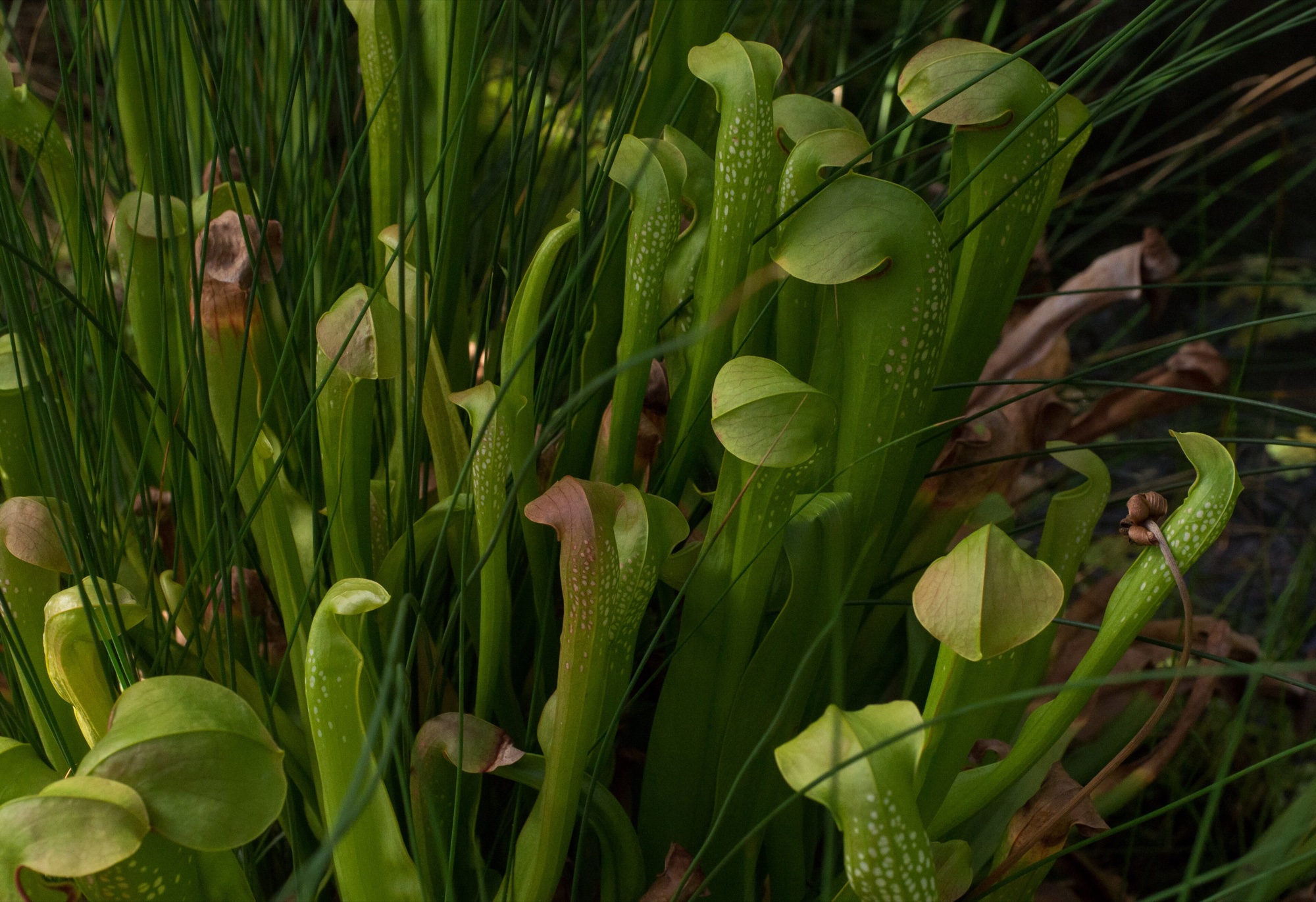
Sarracenia flava, the yellow pitcher plant: yellow-green trumpets up to a metre tall from the southeastern US. Needs full sun, a cold winter and room.
Sarracenia flavaYellow pitcher plant · Yellow trumpetFamily Sarraceniaceae
New to these plants? Read the Sarracenia group introduction first: it explains what the group is, where the plants grow and how the whole group is cared for.
Quick care
IntermediateDifficulty is an editorial assessment for typical home conditions, not a property of the plant.
- Native range
- Southeastern USA coastal plain, from southeastern Virginia through the Carolinas and Georgia to the Florida panhandle and southeastern Alabama; wet pine savannas, seepage bogs and ditch edges.
- Light
- Full sun, all day. One of the most light-hungry carnivorous plants; shaded plants produce few, weak pitchers.
- Water
- Rain, distilled or reverse-osmosis water. Tray method or bog container; keep wet in the growing season and damp in winter.
- Growing medium
- Sphagnum peat moss with perlite or sand, roughly 1:1; a deep pot for the long rhizome and roots.
- Temperature
- Warm to hot summers. Winter cold required, with light frosts tolerated; protect pots from prolonged hard freezes. Hardy outdoors in USDA zone 7, zone 6 with mulch; RHS rating H3.
- Humidity and airflow
- Not critical outdoors; good airflow helps prevent fungal spotting.
- Dormancy
- Required. Three to four months of cool, short days; pitchers brown off and flat non-trapping leaves (phyllodia) often appear in autumn.
- Feeding
- Catches large numbers of insects, including wasps, in its trumpets. No supplementary feeding needed outdoors.
Watch out for
- Pitchers toppling over: often simply full of insects; stake or accept it. Also caused by low light.
- Flat, sword-like leaves without pitchers in late summer: phyllodia, a normal seasonal change, not a disease.
- Brown spots spreading on pitchers in humid, still conditions: fungal; improve airflow and remove badly affected leaves.
- Rhizome rot after a warm, wet winter, or after fertiliser or salty water reaches the rhizome.
- Aphids, scale or mealybugs on new growth in spring, with twisted or stunted pitchers.
About this plant
Sarracenia flava produces upright, trumpet-shaped pitchers, typically 50 to 90 cm (20 to 36 in) tall and occasionally reaching 1 m (3 ft), each topped by a lid that keeps rain out. Nectar around the mouth draws insects, the waxy, downward-pointing hairs inside prevent them climbing out, and digestive fluid at the base of the tube finishes the job. The nectar is not entirely innocent: the plant contains coniine, the alkaloid that makes hemlock poisonous, and extracts can paralyse ants. Whether the amounts in a living pitcher are enough to dope the prey has not been settled. Large flowers with drooping yellow petals open in early spring, March to April across most of the range, before the new pitchers, and have a strong musky smell that many people find unpleasant.
The species grows in open, wet, fire-maintained savannas and seepage slopes of the southeastern US coastal plain. It once formed huge stands; it is much less common now that so much of its habitat has been drained, and at the northern edge of the range, in Virginia, most of the historical sites are gone. Several colour forms are recognised, from all-green and pure yellow through red-veined and red-throated plants to forms with entirely red pitchers.
Light
This is a plant of open savanna and wants full sun from morning to evening. It is one of the carnivorous plants most often disappointed by a windowsill. In shade the pitchers are few, thin and prone to flopping.
Water
Use rain, distilled or reverse-osmosis water. Stand the pot in a deep tray through the growing season or grow the plant in a bog container. Reduce the water to damp in winter.
Growing medium
Sphagnum peat moss with perlite or washed sand in roughly equal parts, with no fertiliser. Some growers prefer a heavier peat mix, roughly 7:3 peat to sand or 4:1 peat to perlite, on the grounds that perlite is slightly alkaline; both mixes grow good plants. The rhizome is thick and the roots are long, so use the deepest pot you can manage; a plant in a shallow pot never reaches full size.
Temperature
Hot summers are no problem while the roots are wet. Winter must be cold enough to force a rest, with light frosts tolerated. In its native range the ground rarely freezes deeply, so pots should be protected from prolonged hard freezing while still being kept cold. For outdoor planting, the species is fully hardy in USDA zones 7 to 9b and can be grown in zone 6 under mulch or a row cover. Its RHS hardiness rating is only H3, meaning it is reliable outdoors in the milder coastal counties of Britain and needs protection elsewhere. The difference reflects the wet, mild British winter rather than a contradiction: a dormant rhizome in a cold frame or under mulch copes with much lower temperatures than an exposed pot of wet peat.
Dormancy
Required. Through autumn the pitchers brown from the top and the plant often produces phyllodia, flat leaves with no trap, which persist through winter. Growth stops for three to four months. Many growers trim dead pitchers in late winter but leave green phyllodia in place, because cutting away green leaves can starve a plant whose rhizome is not yet large.
The species makes one main flush of pitchers from spring to early summer. Expect the finest trumpets then, with phyllodia taking over in late summer.
Feeding
Outdoors the trumpets catch far more than the plant needs, and a pitcher packed with wasps and flies is a familiar sight by late summer. No feeding is needed. Indoors under lights, a few insects per pitcher during the season is sufficient.
Some growers give plants under glass that catch little a dilute foliar fertiliser once or twice a month in the growing season. Fertilising mature plants offers little benefit, fertiliser reaching dead leaf bases can rot the rhizome, and pouring fertiliser into trumpet pitchers can go wrong as well; insects in the pitchers are the safer choice.
Repotting
Divide and repot every three or four years in late winter, or sooner if the growing points have reached the edge of the pot, splitting the rhizome where it has branched. Each division needs roots and at least one growing point. Three to four years suits well-grown plants; waiting up to five is possible, but the earlier figure keeps the medium fresher.
Common problems
Toppled pitchers and phyllodia alarm growers but are usually normal. Genuine problems are mostly fungal spotting in humid, still air and rot in rhizomes kept warm and wet over winter. Both improve with airflow and a proper cold rest. Rhizome rot is also linked to fertiliser and to mineral-rich water, so check both if a crown collapses.
Aphids, scale, mealybugs and moth larvae are the pests to expect. Aphids are the usual spring problem, twisting the new pitchers as they open; a badly deformed pitcher can be cut off once the colony is dealt with. The systemic and carbamate insecticides once used on these plants are now withdrawn or restricted in many places; use a product currently approved for ornamentals where you live, and never an aerosol or an insecticidal soap on carnivorous plants.
Species-specific notes
Sarracenia flava is a parent of many garden hybrids and passes its height and yellow tones to them. Seven varieties are recognised, which intergrade freely where they meet: var. flava (green pitchers with a red throat patch and veining spreading from it, the common Atlantic coast form), var. rugelii (green with a single large red throat blotch and no veining, the usual form of Georgia and the Florida panhandle), var. ornata (heavy red veining over the whole pitcher), var. maxima (green without a throat blotch), var. cuprea (a copper-coloured lid), var. atropurpurea (red pitcher and lid) and var. rubricorpora (a red tube under a green, red-veined lid, from the Florida Gulf Coast). All are the same species and need the same care. Var. atropurpurea keeps its red only in strong, all-day sun, and the lids of var. rubricorpora open green and redden slowly, so do not judge the colour of a new plant in its first season.
Sources
References for the facts on this page.
- International Carnivorous Plant Society: Growing Sarracenia (accessed )
- NC State Extension Plant Toolbox: Sarracenia flava (accessed )
- Kew Plants of the World Online: Sarracenia flava (accessed )
- Flora of North America: Sarracenia flava (accessed )
- Schnell 1998, Carnivorous Plant Newsletter 27(4): the varieties of Sarracenia flava (accessed )
- Royal Horticultural Society: Sarracenia flava (accessed )
- Mody et al. 1976, Experientia 32: 829–830. Isolation of the insect paralyzing agent coniine from Sarracenia flava (accessed )
- Sheridan, Meadowview Biological Research Station: The Sarraceniaceae of Virginia (abstract) (accessed )
- Peter D'Amato, The Savage Garden, Revised Edition (Ten Speed Press, 2013), The American Pitcher Plants chapter. ISBN 978-1-60774-410-8