Plant group
Cobra plant
Darlingtonia, the cobra plant: a single western American species with hooded pitchers. Hardy and striking, but it dies when its roots get warm.
DarlingtoniaCobra plant · Cobra lily · California pitcher plantFamily Sarraceniaceae · One species
Care at a glance
AdvancedNot fussy about air temperature or humidity, but will not tolerate warm roots; straightforward in a cool-summer climate, a project anywhere else.
- Where they grow
- Northern California and southwestern Oregon, USA, from coastal bogs to mountain seeps at about 2,600 m (8,500 ft).
- Trap
- Pitfall pitcher with a hooded, windowed head
- Light
- Full sun to bright part shade. Shade the pot, not the plant, where the sun is hot.
- Water
- Rain, distilled or reverse-osmosis water, kept cool. Water from the top often, stand pots in a tray, and flush with cold water in hot weather.
- Growing medium
- Airy and open: live or long-fibre sphagnum with perlite or pumice, or peat with pumice and orchid bark. Large, pale, drained pots.
- Temperature
- Air temperature matters little; keep the soil below 27 °C (80 °F). Tolerates frost and, when dormant, freezing.
- Dormancy
- Required. A cold winter rest; the pitchers often stay green through it.
- Feeding
- Catches its own insects. No soil fertiliser; a few insects in the pitchers under cover.
Start with
- Darlingtonia californicaThe only species. Buy an established plant that is already making runners rather than a seedling, and buy in spring or autumn, not in a heatwave.
- Darlingtonia 'Othello'A registered all-green cultivar from a Sierra Nevada seep that comes true from seed; identical care, a different look.
Watch out for
- Growing points at the edge of the pot going brown and soft in summer: the roots have overheated; cool the pot and the water.
- No new pitchers and no runners: the plant is too hot, too dark, or in stale medium with no oxygen.
- Fungus gnats breeding in wet sphagnum: a thin layer of sand on the surface deters them.
- Aphids on new growth in spring; scale insects, mealybugs and tortrix moth caterpillars on established plants.
- Pitchers browning from the top in autumn: normal ageing; remove a pitcher only once it is fully brown.
- Pitchers collapsing after a summer purchase: the shock of a hot patio after a cool nursery.
What they are
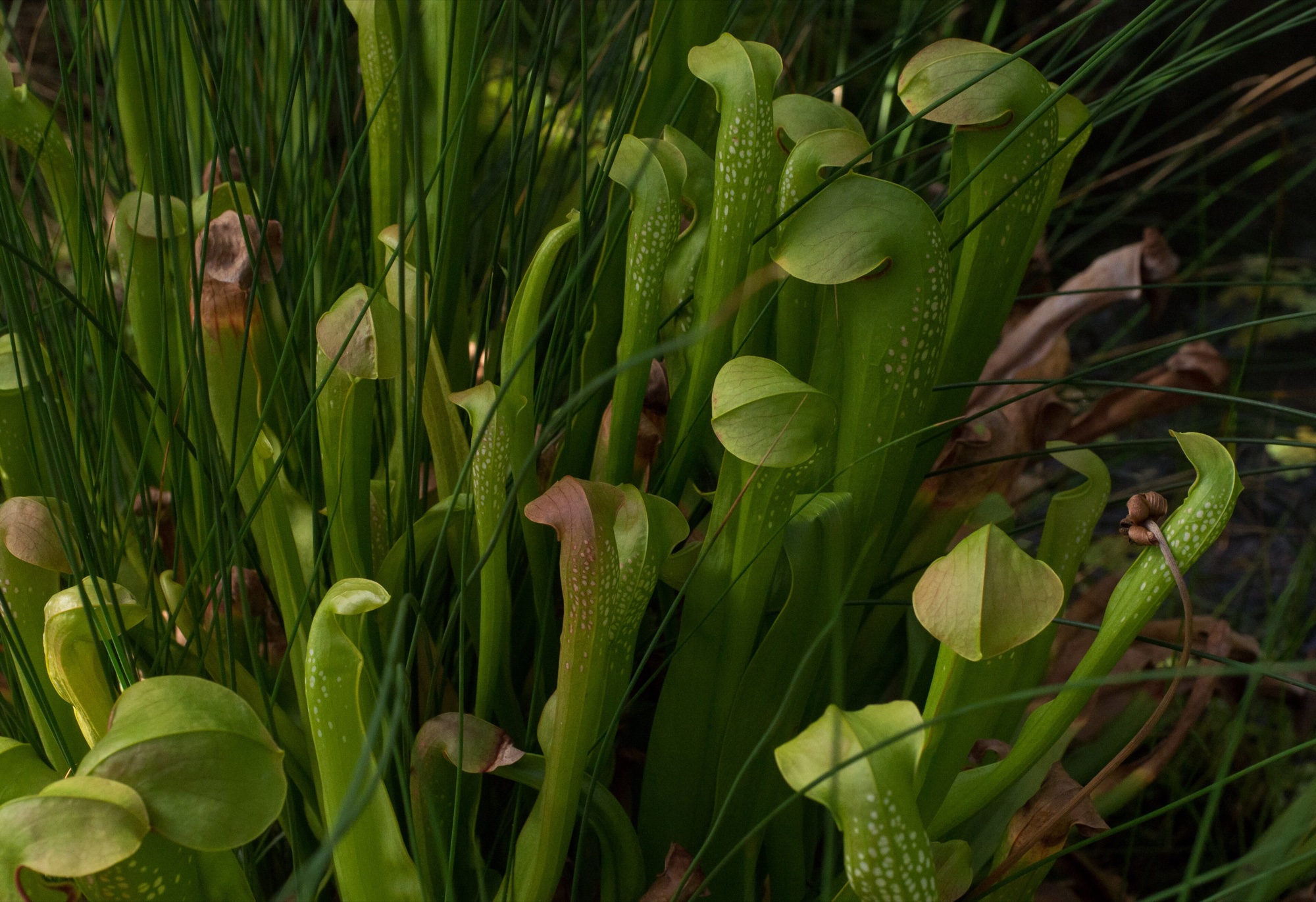
Darlingtonia californica is the only species in its genus and the only member of the pitcher plant family Sarraceniaceae in the western United States. Each leaf is a hollow tube that twists through a quarter to three-quarters of a turn as it rises and swells at the top into a hooded, globe-shaped head speckled with translucent windows. The round opening is underneath the head, facing the ground, and from its rim hangs a two-lobed appendage like a fishtail or a forked tongue. Wild pitchers are usually 40 to 60 cm (16 to 24 in) tall and can reach 1 m (3 ft).
The trap works like a lobster pot. Nectar on the tongue and around the hidden opening draws insects in. Once inside, the bright windows look like exits, so the insect heads for them instead of the mouth; downward-pointing hairs lower in the tube stop it climbing back, and it falls into fluid at the base. No rain gets in; the plant secretes the liquid itself. The family is thought to rely heavily on bacteria and other organisms rather than its own enzymes to break prey down, and a single cobra plant pitcher can house more than twenty species of midge larvae, mites and other arthropods. Bacteria in the fluid also lower its surface tension, which helps hold struggling insects under.
Each growing point sends up one nodding flower on a stalk 50 to 100 cm (20 to 40 in) tall, with yellow-green sepals and dark-veined purple-red petals, from mid April to July. The plant spreads by underground runners up to about 1 m (3 ft) long, so a single clone can carpet a hillside. John Torrey described the genus in 1853, honouring the Philadelphia botanist William Darlington; the plant had been found in 1841 by William Brackenridge of the Wilkes Expedition.
Where they grow
The range is northern California and southwestern Oregon. In California it grows from Del Norte County on the coast southeast through the Klamath Mountains to Nevada County in the Sierra Nevada; in Oregon it runs from Curry and Josephine counties up the coast to Tillamook County. It grows from sea level to about 2,600 m (8,500 ft). The habitat is always the same kind of place: a seep, marshy stream or bog where cold water moves through the ground all year, often on serpentine soils rich in metals that most plants cannot tolerate, with trees covering less than a tenth of the site.
That is the fact that governs everything in cultivation. In the wild cold spring water flows constantly through the root zone, and in a pot the soil must stay below 27 °C (80 °F) for the plant to survive long term.
The species is not rare in the formal sense: the California Native Plant Society ranks it 4.2, a watch list for plants of limited distribution, and neither state lists it. It is nevertheless threatened by road building, drainage, logging, ranching, drought and collectors, and collecting it is illegal in Oregon, where the 18-acre Darlingtonia State Natural Site near Florence is the only state park set aside for a single plant.
The range in cultivation
There is one species and little variation on sale. Plants differ in how much red they carry, from green with a red tongue to a deep red flush over hood and tube in strong sun. ‘Othello’, registered in 1998, is the one named cultivar most growers will meet: it lacks red pigment entirely, so even the flowers are green, and it comes true from seed as long as the seedlings are also green.
Where a plant came from matters more than its name. High-elevation stock tolerates cold better and heat worse than coastal stock; nurseries rarely say, so ask. Most cultivated plants are thought to descend from coastal populations.
Growing them
Light
In the wild the plant grows in full sun and in partial shade. It needs less light than Sarracenia but still appreciates strong light; colour is best in sun. The practical rule is to give the leaves sun and keep the pot out of it, since a dark pot in afternoon sun heats the root zone far above the limit.
Water
Rain, distilled or reverse-osmosis water, and cool. Unlike most carnivorous plants this one wants watering from the top as well as from a tray, and often, so that fresh cool water moves through the medium as spring water does in habitat. In hot weather growers put ice cubes of pure water on the surface daily, pump chilled water through the pots or float pots in a deep tray.
Growing medium
Open and airy, so that oxygen reaches the roots and the mix drains and cools quickly. Several recipes work: for mature plants, chopped long-fibre sphagnum, peat, fine orchid bark and washed pumice in about 2:1:1:2, or 4:1 long-fibre sphagnum to perlite, or 4:1 peat to pumice. Use large, wide, drained pots, which stay cooler and more stable, and never a small undrained one; pale glazed or terracotta pots are better than black plastic for the same reason.
Temperature
The limit is soil temperature, not air. Keep the root zone below 27 °C (80 °F); collapse comes in hot weather and shows first at the growing points along the pot edge, where the soil is warmest. Cool summer nights of 10 to 16 °C (50 to 60 °F), or below 18 °C (65 °F) in a greenhouse, are often recommended, and they do help cool a pot, but air temperature is not the issue if the roots are cool: measure the soil. The species suits USDA zones 7a to 10b and is difficult outside its cool native range. Winter is easy. Fully dormant plants survive being frozen solid as long as the rhizomes are not exposed; a cold frame, garage or deep mulch of pine needles or snow limits freeze and thaw cycles.
Dormancy
Required, and easy to give anywhere with a cold winter. Growth stops, but the pitchers usually stay green through the rest and are removed only once brown. Next year’s flower buds are already sitting at the growing point.
Feeding
The plant catches its own insects, and under cover a few insects dropped into the pitchers are enough. Fertilising the soil does not help, unlike with Sarracenia; a very dilute urea-free fertiliser in the pitchers can help if it does not burn them. A light foliar feed with an acidic orchid fertiliser once or twice a month is an alternative, but insects are simpler.
Common mistakes
- A black pot on a sunny patio or a south-facing windowsill: the leaves enjoy it, the roots cook.
- Stagnant, warm tray water all summer; refresh it and water from the top.
- A small undrained pot, or fertiliser in the soil.
- Dividing or taking runner cuttings from a young plant; wait until a clump is about three years old.
- Expecting speed. Maturity takes two to five years from seed, and full-size leaves seven to ten.
Which to start with
There is one species, so the real decision is whether to grow it at all. Where summers are cool, on the Pacific coast, in Britain and northern Europe or at altitude, it is an ordinary hardy bog plant that spreads by runners and needs little beyond pure water and winter cold. Where summer days pass 30 °C (86 °F) for weeks, it survives only if you keep the water and the pot cool every day, and a first-time grower is better served by an American pitcher plant, which looks related and wants heat. If you do start, buy an established plant with runners from a nursery in a cool climate, in spring or autumn.
Going further
Runner cuttings are the dependable way to more plants; leaf pullings and seed, which needs about four weeks of cold damp stratification, also work. All three are in the propagation entry for Darlingtonia. A plant that thrives will fill a tub and then a bog bed, and the in-ground bog, where soil stays cool in summer, is where the plant does best. For the eastern relatives that share the family and the trap, see the American pitcher plants.
Sources
References for the facts on this page.
- Flora of North America: Darlingtonia californica (accessed )
- Flora of North America: Darlingtonia (accessed )
- Flora of North America: Sarraceniaceae (accessed )
- International Carnivorous Plant Society: Growing Darlingtonia (accessed )
- International Carnivorous Plant Society: Darlingtonia vegetative propagation (accessed )
- Oregon State Parks: Darlingtonia State Natural Site (accessed )
- USDA Forest Service, Plant of the Week: Darlingtonia californica (accessed )
- CNPS and USDA Forest Service species evaluation form: Darlingtonia californica (with Jepson eFlora description) (accessed )
- Royal Horticultural Society: Darlingtonia californica (accessed )
- NC State Extension Plant Toolbox: Darlingtonia californica (accessed )
- Armitage, D. W. 2016. Bacteria facilitate prey retention by the pitcher plant Darlingtonia californica. Biology Letters 12: 20160577 (accessed )
- Rice, B. 1998. Darlingtonia 'Othello'. Carnivorous Plant Newsletter 27(2): 40–42 (accessed )
- ICPS Carnivorous Plant Names Database: registered Darlingtonia cultivars (accessed )
- Peter D'Amato, The Savage Garden, Revised Edition (Ten Speed Press, 2013), The Cobra Plant chapter. ISBN 978-1-60774-410-8