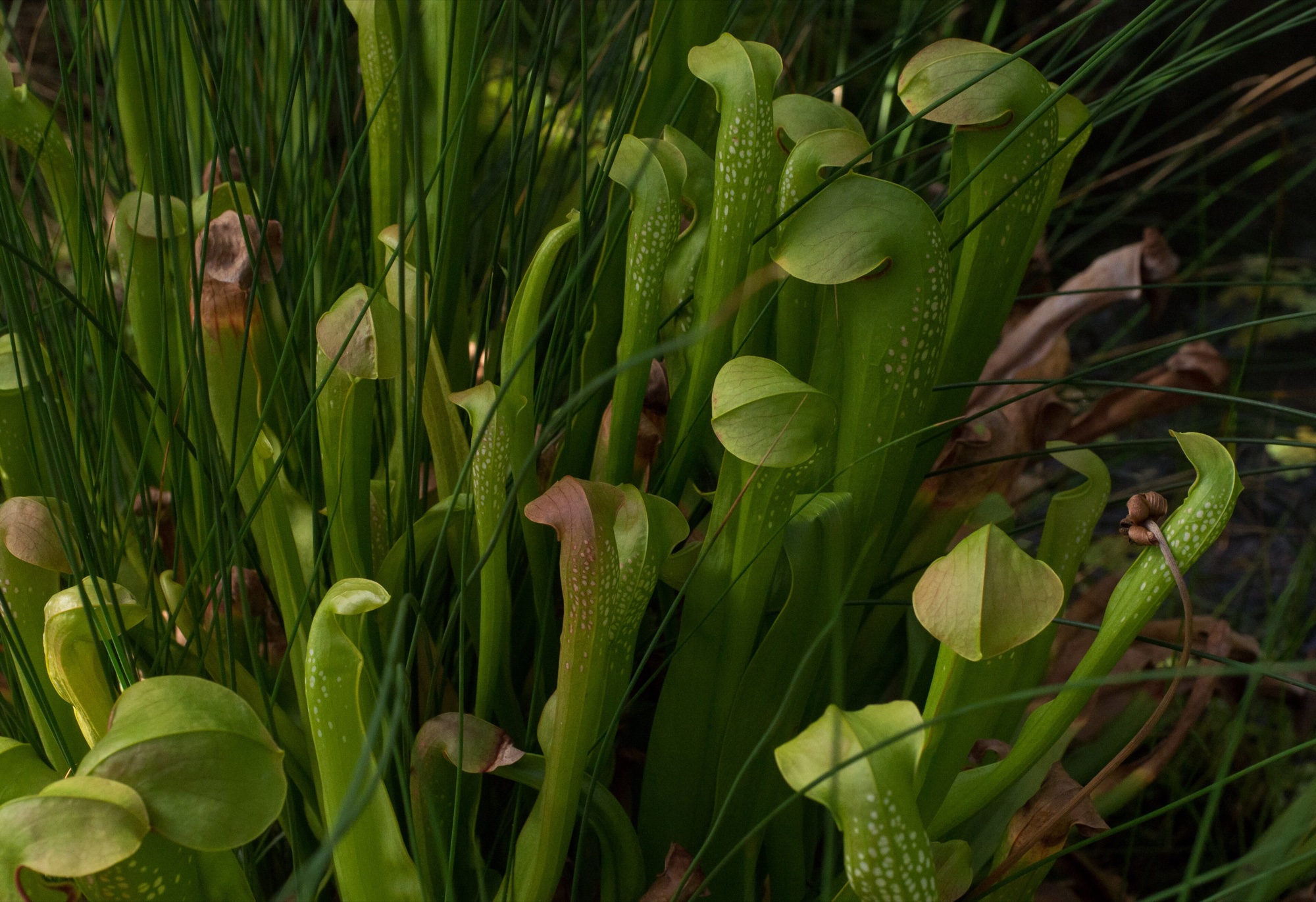
Drosera
Cape sundew
Drosera capensis, the Cape sundew: a forgiving South African species with sticky strap-shaped leaves. No dormancy requirement; tolerates a range of light.
Drosera capensisCape sundewFamily Droseraceae
New to these plants? Read the Drosera group introduction first: it explains what the group is, where the plants grow and how the whole group is cared for.
Quick care
BeginnerDifficulty is an editorial assessment for typical home conditions, not a property of the plant.
- Native range
- South Africa: the south coast and its sandstone ranges from the Cape Peninsula east to Port Elizabeth, and north to the Gifberg; permanently wet seeps, stream banks, dam margins and coastal wetlands in fynbos, from sea level to about 1,800 m (5,900 ft).
- Light
- Bright light with some direct sun. Tolerates a bright windowsill; colours red and makes more dew with more light. Under glass, shade it from the hottest midday sun.
- Water
- Rain, distilled or reverse-osmosis water. Tray method year-round; the medium should stay wet in the growing season and moist in winter.
- Growing medium
- Sphagnum peat moss with perlite or sand, roughly 1:1. Long-fibre sphagnum also works.
- Temperature
- Best between roughly 10 and 30 °C (50 to 86 °F); copes with brief spells outside that. Frost kills the leaves, but established plants usually regrow from the roots.
- Humidity and airflow
- Moderate household humidity is fine; dew production falls in very dry, hot air.
- Dormancy
- None required. Growth slows in low winter light and the plant may lose dew; it continues from the same rosette in spring.
- Feeding
- Catches small flies on its own, including fungus gnats indoors. Occasional feeding, or a very weak monthly foliar feed, is optional.
Watch out for
- Leaves without dew: usually low light, low humidity with hot dry air, the pot drying out, or the shock of a recent repotting.
- Seedlings appearing in every nearby pot: the species self-pollinates and sets abundant seed.
- Leaves dying after frost: cut back and keep moist; new growth usually appears from the root.
- Aphids, thrips or mealybugs distorting new leaves and flower stalks; never treat with a soap-based insecticide.
- Crown getting smaller late in the season: continuous flowering drains the plant; remove the stalks.
About this plant
Drosera capensis forms a semi-erect rosette of narrow, strap-shaped leaves. A typical cultivated plant has leaves 8 to 15 cm (3 to 6 in) long including the stalk, with the sticky blade making up about half that length; robust plants can reach 25 to 30 cm (10 to 12 in) across with leaves of 16 cm (6 in). Each blade carries hundreds of stalked glands tipped with a drop of sticky mucilage. Insects stick to the drops, the surrounding tentacles bend inward over an hour or two, and the whole leaf often curls around larger prey. Digestion takes several days and the leaf then unfurls, leaving the dry husk behind.
The species grows in permanent seeps, on stream banks and around dam edges along the whole south coast of South Africa and its sandstone mountains, from sea level to about 1,800 m (5,900 ft). Despite its reputation for fecundity it is often local and uncommon in the wild. In cultivation it is one of the most widely grown carnivorous plants and has escaped into the wild in several countries, which says something about how tolerant it is.
Light
The Cape sundew is flexible about light. It survives on an ordinary bright windowsill, but it looks its best with several hours of direct sun, when the tentacles redden and every leaf carries a full load of dew. If the leaves are green and sparsely dewed, it wants more light rather than more humidity. The one caution is heat: under glass, shade it from the hottest sun, because a pot that bakes behind a window loses its dew.
Water
Like most carnivorous plants it needs mineral-poor water: rain, distilled or reverse-osmosis. Stand the pot in a shallow tray of water during the growing season. It tolerates being wetter than a Venus flytrap and is one of the few carnivorous plants that forgives the occasional dry spell, though repeated drying costs it leaves.
Growing medium
Use sphagnum peat moss mixed with perlite or washed sand, or long-fibre sphagnum. No fertiliser or compost. The plant is not fussy about the exact ratio.
Temperature
The plant tolerates roughly 10 to 35 °C (50 to 95 °F) and is happiest in the middle of that range, with the best growth a little lower, between about 4 and 27 °C (40 and 80 °F). It survives brief spells from freezing up to 38 °C (100 °F); treat those extremes as something the plant survives, not something to aim for. It will take a hot summer if the pot is kept wet, and it sits through cool winters indoors without complaint. Its RHS hardiness rating is H3, meaning it needs protection below about -5 °C (23 °F). Frost kills the foliage, but mature plants with a healthy root system usually regrow from the roots in spring; wild plants at high altitude do the same every winter, dying back to a protected growing point under snow. This is why it is sometimes grown outdoors in mild climates.
Dormancy
None is required. In short, dim winter days the plant slows, may stop producing dew and can look tired; this is a response to light, not a dormancy that needs to be provided. Growth returns as days lengthen. The only true dormancy the species shows is the frost die-back of mountain populations described above, and a plant that has lost its crown to cold should be treated as resting, not dead.
Feeding
The plant catches fungus gnats, fruit flies and other small insects on its own, and many growers keep it near other houseplants for exactly this reason. Feeding is optional; a small insect placed on a leaf every couple of weeks in summer speeds growth. A foliar feed is the alternative: a monthly spray at a quarter of the label strength or weaker, used with care. Do not fertilise the medium.
Repotting
Repot every year or two in spring. Older plants form a stem of dead leaves below the living rosette; you can bury this or cut the rosette off and re-root it. A freshly moved plant often stops making dew for a few weeks; new leaves recover. If an old crown dies, wait before discarding the pot, because new shoots usually sprout from the base of the stem. The species is also easy to propagate from leaf cuttings laid on wet medium and from root cuttings, and it self-seeds freely.
Common problems
The usual complaint is a lack of dew. Check light first, then water, then air: a plant next to a heater in dry winter air often stops producing mucilage until conditions improve. Aphids, thrips and mealybugs occasionally distort the new growth; pick them off or use a diluted insecticide, but never a soap-based one, which damages sundew leaves.
Flower stalks appear from spring to autumn, sometimes into winter, each carrying a few dozen pink flowers about 2 cm (0.75 in) across that open one or two at a time, for a few hours in good light, and self-pollinate. A single stalk can shed well over a thousand seeds, so unless you want seedlings in every pot, cut the stalk before the capsules open, about four to five weeks after the flowers. There is a second reason to remove the stalks: a plant allowed to flower all season puts its energy there and ends the summer with a noticeably smaller crown.
Species-specific notes
Several forms are grown under this name and their care is identical. Growers have long separated a wide-leaved form, which is the usual “typical” plant in cultivation and forms a stem up to about 15 cm (6 in) tall, from a narrow-leaved form, which is in fact the commoner plant in the wild and holds an RHS Award of Garden Merit. The white-flowered plant is the registered cultivar ‘Albino’, often sold as ‘Alba’, also with an Award of Garden Merit; it has colourless tentacle stalks and no red in the leaves. The all-red form keeps its colour only in strong sun or under intense artificial light, and goes green in winter or far from the lamps. Plants sold as “giant” are usually either large wide-leaved plants or long-stalked narrow-leaved ones; both can make rosettes 30 cm (12 in) across. There are also miniature plants that never exceed about 10 cm (4 in).
Sources
References for the facts on this page.
- International Carnivorous Plant Society: Growing subtropical Drosera (accessed )
- Kew Plants of the World Online: Drosera capensis (accessed )
- RHS: Carnivorous plants growing guide (accessed )
- New Zealand Plant Conservation Network: Drosera capensis (accessed )
- RHS: Drosera capensis, Drosera capensis 'Albino' and Drosera capensis narrow-leaved (accessed )
- Gibson, R. 2020. Drosera capensis: some variation in cultivation and in the wild. Carnivorous Plant Newsletter 49(4): 173-180 (accessed )
- SANBI PlantZAfrica: Drosera capensis (accessed )
- Peter D'Amato, The Savage Garden, Revised Edition (Ten Speed Press, 2013), The Sundews chapter. ISBN 978-1-60774-410-8