Plant group
Sun pitchers
Heliamphora, the sun pitchers: South American pitcher plants from cool, rain-soaked Venezuelan mountain tops. Advanced plants; a few are easier under lights.
HeliamphoraSun pitchers · Marsh pitcher plantsFamily Sarraceniaceae · Around 24 species, with more awaiting description
Care at a glance
AdvancedHybrids and the typical forms of H. minor, H. heterodoxa and H. nutans are manageable in a cool, bright, humid tank; the rest need the conditions of a cloud-swept mountain top.
- Where they grow
- The tepuis, flat-topped sandstone mountains, of the Guiana Highlands in Venezuela, Guyana and northern Brazil, mostly between 1,200 and 2,800 m (3,900 to 9,200 ft).
- Trap
- Pitfall: a lidless, rain-filled pitcher with a nectar spoon at its tip
- Light
- Very bright. Under lights, around 20 W of LED per 30 cm (1 ft) square for about 15 hours a day, close to the plants and reaching them from the side; a sunny but cool greenhouse otherwise.
- Water
- Pure water only: rain, distilled or reverse osmosis. Pots stand in a few millimetres of water or are watered through daily; the medium must never dry out and must never smell sour.
- Growing medium
- Open and low in organic matter: equal parts long-fibre sphagnum, perlite and a coarse aquatic planting grit, or sphagnum with perlite or coarse sand.
- Temperature
- Cool. Wild summits run 7 to 23 °C (45 to 74 °F) and never freeze. In cultivation keep days below about 26 °C (79 °F) for large plants and below 30 °C (86 °F) for all; above 40 °C (104 °F) is fatal. Light frost is survived.
- Humidity and airflow
- High. Unless the room stays above 70 percent, grow in a terrarium or other enclosure.
- Dormancy
- None. Growth continues all year under steady light and cool temperatures.
- Feeding
- Needed with these low-organic mixes: a monthly very dilute urea-free orchid fertiliser or one or two slow-release pellets in mature pitchers, or small insects. Fertiliser in the medium is risky.
Start with
- Heliamphora minorA small, clumping species from Auyán Tepui, one of the easier ones and compact enough for a tank under lights.
- Heliamphora heterodoxaRobust and tolerant, from lower slopes than most; the typical form is one to begin with.
- Heliamphora heterodoxa × minorThe hybrid of the two easy species, widely sold; hybrids in general suit beginners, and this one is notably vigorous.
- Heliamphora nutansThe first species described, from Mount Roraima, and probably the commonest in cultivation; typical forms are a good starting point.
Watch out for
- Plant blackens and collapses within days in warm, humid conditions: a vascular fungus that spreads in soil and water; isolate and discard the medium.
- Pitchers browning from the top in a dry room: humidity too low; move to an enclosure.
- Growth stalls and new pitchers are small and green: not enough light, or light only from above.
- Medium smelling sour, roots brown: stagnant, waterlogged or broken-down mix; repot into a fresh open blend.
- Pitchers snapping during handling: they are brittle; support them when repotting.
- Fungus gnats in the medium: a sand mulch over the surface discourages them.
What they are
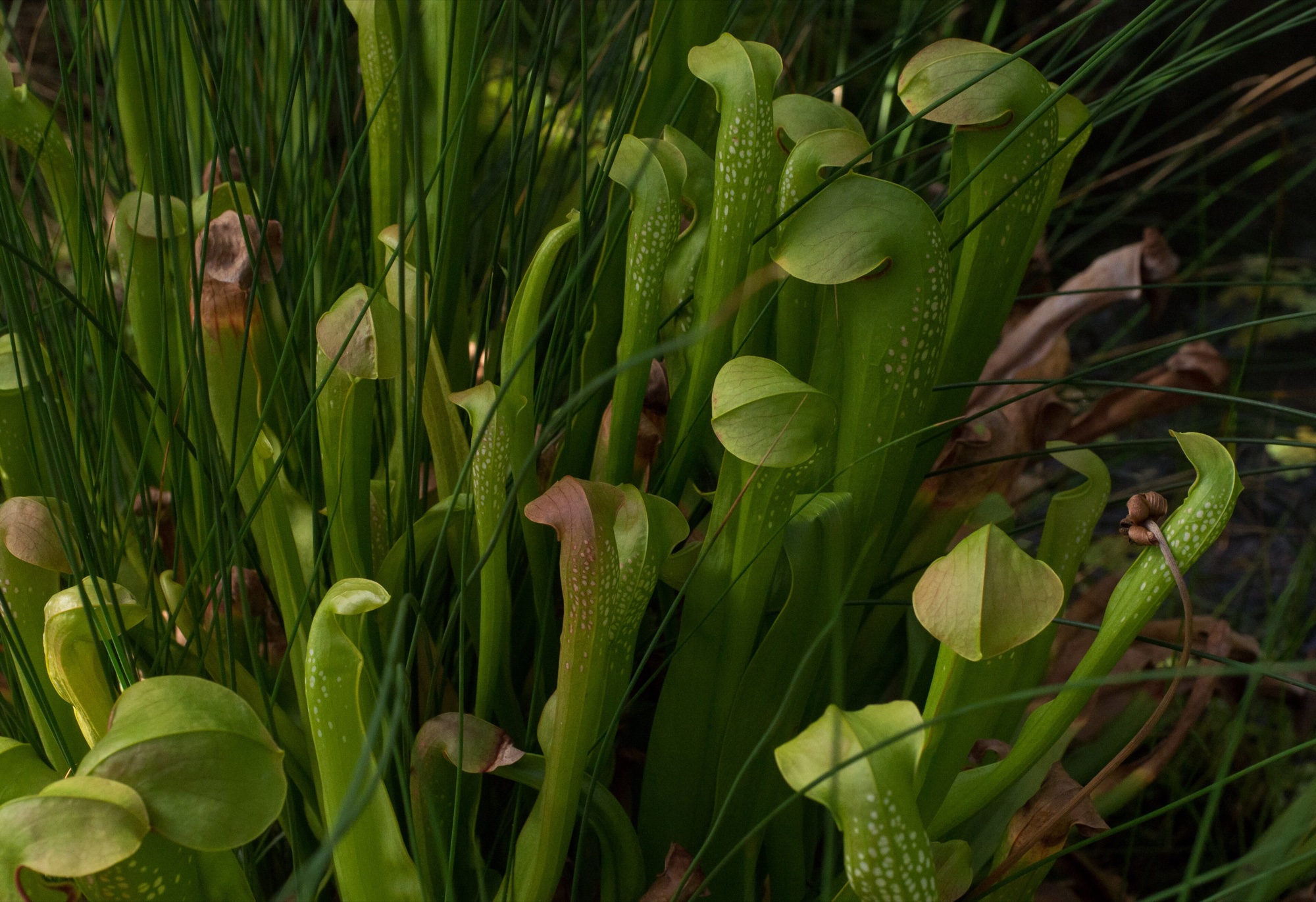
Heliamphora are the South American branch of the family that holds Sarracenia and Darlingtonia, and the most species-rich genus in it. Each pitcher is a rolled leaf, funnel- or bell-shaped, with a seam down the front and no lid at all. Rain falls straight in, and a small hole or slit on the front seam lets the surplus out, so the fluid stands at a level set by that opening; this drain is the feature that defines the genus. At the tip of the pitcher’s back sits the nectar spoon, a cap-like structure that colours up in strong light and secretes the nectar that draws prey; its shape runs from a tiny knob to a hollow chamber, and in Heliamphora folliculata it is a closed bubble of nectar glands. Inside, downward-pointing hairs stop insects climbing out, and a narrowing near the waterline keeps them in the fluid.
The prey is mostly ants. Of the species examined, only Heliamphora tatei has been found to secrete its own digestive enzymes; the others appear to rely on bacteria in the fluid to break prey down. Plants in low light stop producing their carnivorous features, which growers see in a tank with weak lamps.
Flowers come on tall stalks, several to a stem, white to pinkish and without true petals. The anthers release pollen only when vibrated, which bees do in the wild; growers use a tuning fork.
The first species, Heliamphora nutans, came from Mount Roraima. The genus stayed at a handful of species for most of the twentieth century and reached 23 by 2011, with Heliamphora electrum described in 2024 and more still to be named.
Where they grow
The whole genus is confined to the Guiana Highlands of southern Venezuela, western Guyana and northern Brazil, almost all of it on the summits of the tepuis, sandstone table mountains rising above the savanna. Most species grow between 1,200 and 2,800 m (3,900 and 9,200 ft), a few on the slopes above about 800 m (2,600 ft). The summits are cool, cloudy and wet beyond anything a temperate grower expects: 7 to 23 °C (45 to 74 °F) through the year, never freezing, with 2 to 4 cm (roughly 1 to 1.5 in) of rain on a typical day. The rock holds almost no soil, and the plants grow in patches of sand, grit and their own dead leaves, in full exposure; H. folliculata grows on steep, well-drained rock, rarely in wet places and never in shade.
The lesson for cultivation is direct: light at the intensity of a mountain top, roots cool and constantly wet but never stagnant, water with nothing dissolved in it, and air that is humid without being hot. There is no dry season and no winter, so there is nothing to simulate except an even, cool, bright year.
The range in cultivation
Tissue-cultured plants and hybrids of many species are now routinely offered. The plants to begin with are hybrids, and the typical or generic forms of Heliamphora heterodoxa, Heliamphora nutans and Heliamphora minor. H. minor is small and forms tight clumps; H. heterodoxa, which comes from lower, warmer ground than most, tolerates a wider range; H. nutans is the original species and probably the commonest in cultivation. Hybrids between them, above all H. heterodoxa × minor, combine the parents’ tolerance with extra vigour, which is the reason to start with hybrids. The large species of the high summits, such as Heliamphora ionasi, Heliamphora tatei and Heliamphora elongata, are for a grower who has kept the easy ones for a few years; H. elongata wants to be kept deliberately chilly, and Heliamphora pulchella rots if flooded with stagnant water.
Growing them
Light
Very bright, and from the side as well as above. Artificial light is the easiest method: at least 20 W of LED lighting, or about 1,200 lumens, per 30 cm (1 ft) square for about 15 hours a day, with the lamps 10 to 15 cm (4 to 6 in) above the plants in a reflective enclosure; light from the top alone is not enough. A greenhouse works if it is very bright and kept cool. A windowsill is unlikely to be bright enough.
Water
Rain, distilled or reverse-osmosis water; tap water passes only if almost mineral-free, and softened well water does not. Growers differ on method: some keep pots standing in a few millimetres of water, others water through daily or every other day and drain the excess, and some top-water every day with no tray. Whichever you choose, the medium must never dry out and must never smell of decay; daily flooding, which the wild plants get, is not required.
Growing medium
Low in organic matter and open. A good mix is equal parts long-fibre sphagnum, perlite and a coarse aquatic planting grit; sphagnum with perlite or coarse sand also works. Orchid bark breaks down fast and can carry fertiliser, so avoid it in a mix expected to last two years between repottings. A 1 cm (0.4 in) mulch of sand keeps moss and fungus gnats down; live sphagnum on the surface overgrows small plants.
Temperature
Cool. The tolerated ceiling is 30 °C (86 °F), large plants die after prolonged spells above 26 °C (79 °F), and 40 °C (104 °F) is fatal. Light frost is survived. Some growers treat a nightly drop to 7 to 16 °C (45 to 60 °F) as a requirement and cool their tanks with ice packs, but night cooling is unnecessary as long as the medium does not heat up by day. What matters is that the roots stay cool; in a warm room that means an air-conditioned space, a basement or a chilled tank.
Humidity
High. Unless a room stays above 70 percent, the plants need an enclosure, usually a terrarium with reflective sides; after division, bag the plant if the enclosure is below 85 percent. The vascular fungus that is the main killer of collections thrives in warm, saturated conditions and can take a plant in under ten days at 28 °C (82 °F).
Dormancy
None. The plants are grown under fifteen hours of light all year round. A plant that stops in winter is cold, dark or sick rather than resting.
Feeding
Unlike most carnivorous plants, these need feeding, because the recommended mixes hold almost no nutrients. Feed mature pitchers monthly with a urea-free orchid fertiliser at about half a teaspoon per 4 litres (1 US gallon), or with one or two slow-release pellets per pitcher, without overfilling so that the dose ends up in the medium. Fertiliser in the medium is possible at around 70 parts per million with thorough top watering between doses, but species vary in tolerance and overdoing it kills. Insects also work, from fruit flies for seedlings to crickets and woodlice for large plants, and a foliar feed once or twice a month is adequate on its own.
Common mistakes
Growing them warm: a sunny south window in summer, a greenhouse without cooling, or a tank whose lamps heat the medium will all kill plants that looked healthy a week before. Weak light, or light from above alone. Tap water. A stagnant, peat-heavy mix that goes sour. Skipping fertiliser in a mineral mix, then wondering why growth has stopped. Moving a freshly divided plant straight back into open air. Snapping the brittle pitchers through rough handling. And reusing medium or sharing water between pots, which is how the vascular fungus travels.
Which to start with
Heliamphora minor, Heliamphora heterodoxa or the hybrid between them, bought as an established division or tissue-culture plant rather than a seedling. Put it in a reflective tank under strong LED light in the coolest room you have, in an open sphagnum and perlite mix standing in a few millimetres of pure water, and feed the pitchers monthly. Heliamphora nutans is the alternative if a typical form is offered. The genus is one of the easier carnivores or one of the harder ones depending on the conditions you can provide: with a cool, bright, humid enclosure these three are not difficult, and without one no species is easy.
Going further
A well-grown plant divides itself, especially around flowering, and division at natural break points is the standard way to multiply it; leaf pullings with a small pitcher attached root in six months to a year; seed needs hand pollination between flowers of the right age and no cold treatment, though seedlings are slow. The Heliamphora propagation entry gives the steps. From the easy species the path leads to the summit specialists. Researching an unfamiliar species is worth reading before buying any Heliamphora beyond the first three, because the altitude of its home tepui tells you most of what you need to know.
Sources
References for the facts on this page.
- International Carnivorous Plant Society: Growing Heliamphora (accessed )
- Liu, S. and Smith, S. D. 2023. Replicated radiations in the South American marsh pitcher plants (Heliamphora) lead to convergent carnivorous trap morphologies. American Journal of Botany 110: e16230 (accessed )
- Jaffe, K., Michelangeli, F., Gonzalez, J. M., Miras, B. and Ruiz, M. C. 1992. Carnivory in pitcher plants of the genus Heliamphora (Sarraceniaceae). New Phytologist 122: 733-744 (abstract via AGRIS) (accessed )
- Wistuba, A., Harbarth, P. and Carow, T. 2001. Heliamphora folliculata, a new species of Heliamphora (Sarraceniaceae) from the Los Testigos table mountains in the south of Venezuela. Carnivorous Plant Newsletter 30(4): 120-125 (accessed )
- Golos, M. R., Nerz, J., Mey, F. S. and Wistuba, A. 2024. Heliamphora electrum (Sarraceniaceae), an enigmatic species of marsh pitcher plant from the Sierra de Lema of Venezuela. Carnivorous Plant Newsletter 53(1): 4-51 (accessed )
- Wistuba, A., Carow, T. and Harbarth, P. 2002. Heliamphora chimantensis, a new species of Heliamphora (Sarraceniaceae) from the Chimanta Massif. Carnivorous Plant Newsletter 31(3): 78-82 (abstract) (accessed )
- Peter D'Amato, The Savage Garden, Revised Edition (Ten Speed Press, 2013), The Sun Pitchers chapter. ISBN 978-1-60774-410-8